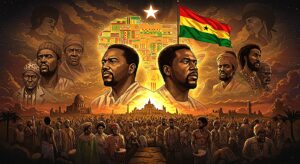
They buried it in silence, hoping we would forget. Buried it beneath borders drawn in Berlin, beneath flags soaked in imperial compromise, beneath textbooks that teach us everything but our unity. They buried it beneath names we did not choose, languages we were forced to speak, religions that taught us to bow before foreign gods while forgetting our own divinity. But they failed to kill the dream, because it was never theirs to end. Pan-Africanism is not a theory on paper. It is the pulse of a people too stubborn to die, too wise to assimilate, too old to forget who they are. It is the memory of wholeness before we were broken. It is the whisper of the ancestors in Accra, in Kingston, in Harlem, in Addis Ababa. It is a fire that flared in the eyes of Marcus Garvey and roared in the mind of Kwame Nkrumah. It is the dream that refused to die.
Garvey saw it first in this modern age, clear and loud as a trumpet. A Black man born in the belly of colonial Jamaica who dared to say, without flinching, that Black people are not inferior, not scattered by accident, and not waiting to be saved. He did not ask permission to love Africa. He declared it. Garvey raised the Black Star and told us to look homeward, not in shame but in triumph. His ships never sailed as planned, but his vision crossed oceans. He gave our people a map—psychological, spiritual, militant. They called him mad, tried to erase him, but they could not silence the storm he awakened. He made millions stand taller in the streets of Harlem, in the hills of St. Ann, in the corridors of Lagos. He reminded the lost that they were never lost to their ancestors.
Then came Nkrumah, and the dream took root in African soil. Ghana’s independence was not merely symbolic—it was prophetic. When he stood before the nation and declared that the independence of Ghana was meaningless unless it was linked to the total liberation of Africa, he was speaking with the thunder of Garvey in his chest. Nkrumah saw that African freedom must be continental or it would be crushed. He tried to build more than a nation. He tried to build a future. The Organization of African Unity was his scaffold, the African Union his unfulfilled legacy. They mocked him, isolated him, overthrew him. But even in exile, he spoke like a man possessed by destiny. He did not speak for Ghana alone—he spoke for a continent robbed of its wholeness and a diaspora still bleeding from the transatlantic lash.
And what a diaspora it was. Fela Kuti in Nigeria, riddling his songs with rebellion. Bob Marley, Peter Tosh, and Burning Spear carrying the Rastafari message that Haile Selassie was not just a man, but a symbol of Black sovereignty reclaimed. The Rastas understood what many intellectuals forgot—that spiritual liberation is a weapon. That until the African soul is decolonized, the African mind cannot be. Walter Rodney saw it too, warning us that the underdevelopment of Africa was not a tragic accident—it was a design. Cheikh Anta Diop gave us back our chronology, told us that Egypt was Black and so were we. Amílcar Cabral reminded us that cultural resistance precedes armed struggle, and Thomas Sankara lived that truth, governing as if revolution were not a slogan but a sacrament.
Yet for all their brilliance, we are still here—fragmented, co-opted, distracted. Our enemies are better funded, more organized, and always watching. They know that a united Africa would end their feast. They know that Pan-Africanism is not romanticism. It is the one threat they cannot manage. A continent in control of its resources, speaking to itself across colonial languages, trading with itself, protecting its people, valuing its culture, and defending its dignity—that is a nightmare to every empire that has fattened itself on African division. That is why they fund tribalism, inflame borders, weaponize NGOs, and install puppets in power. That is why they mock Pan-Africanism as naïve, while they collaborate across continents to ensure its failure.
But the dream still breathes. You can hear it in the digital voices reconnecting diaspora to motherland, in the resurgence of African philosophies, in the stubborn pride of Black youth naming themselves in Swahili, Yoruba, and Twi. You can see it in the dreadlocked prophets still shouting on street corners, in the farmers who refuse GMOs, in the creators redefining what it means to be African. The dream walks quietly in Mali, drums loudly in the Caribbean, and speaks many tongues in Europe and North America. It walks with the uncolonized spirit of the people. It cannot be shot, jailed, or buried. It rises.
So what now? Will we be the generation that finally moves from slogans to systems? Will we build our own media, our own currencies, our own schools of thought? Will we stop waiting for the colonizer to validate our dreams? Pan-Africanism is not nostalgia—it is necessity. The global Black family is one body severed by time and trauma, and it is time to mend what was broken. No foreign solution will save us. No borrowed flag, no IMF bailout, no Western institution can do what we must do for ourselves. Our salvation will not come from Geneva. It will rise from Kinshasa, from Port of Spain, from Dakar, from Cape Coast, from Bahia.
The dream of Garvey and Nkrumah lives in us, but only if we live it. Not by quoting them, but by embodying them. By refusing to think small. By refusing to be enemies of each other. By refusing to let colonial residue define our futures. Africa is not behind. It is rising. And its rising will shake the world if we let it.
Pan-Africanism is not dead. It is waiting.
And now the question turns to us.
Will we answer?