Freedom. The word is chanted in anthems, etched on monuments, and sold like perfume in parliaments, pulpits, and political campaigns. But what if freedom, as Africa inherited it, is a lie so elegant, so well-dressed in law and democracy, that we mistake it for truth? What if the thing we celebrate each Independence Day is not liberation, but a transition—from one form of domination to a subtler, more insidious one?
To speak of freedom in the African context is to step into a room thick with contradiction. On one wall hangs the photograph of Kwame Nkrumah raising the flag of Ghana, bright with hope. On the opposite side stands the ghost of Thomas Sankara, betrayed by a system that feared the very freedom he embodied. And in the center of the room, we, the children of this fractured inheritance, stand confused—chanting slogans, voting in rigged systems, quoting Fanon but submitting to the IMF.
So let us tear off the polite veil. Let us interrogate this word—freedom—with the seriousness it demands, not in the language of colonial jurisprudence, but in the blood-and-bone lexicon of lived African experience.
The Political Illusionist: “We are free, but not functional.”
The first voice we hear is that of a seasoned political scientist, fresh from a symposium at a prestigious Western university. He begins with data—GDPs, democracy indexes, anti-corruption watchdog reports. “Africa,” he asserts, “is free. The problem is what we’ve done with that freedom.” He points to regular elections, open markets, and burgeoning tech hubs in Nairobi and Lagos. He dismisses dependency theory as outdated and believes that the continent’s primary enemy is mismanagement, not imperialism.
But this view, while not entirely false, reeks of technocratic detachment. It ignores that many African states are free to choose their flavor of bondage—whether through Chinese infrastructure debt, Western security partnerships, or the omnipresent chokehold of the dollar. These are not sovereign choices. They are acts of necessity masquerading as agency.
The freedom to mismanage one’s chains is not freedom.
The Revolutionary: “Africa was never decolonized. Only recolored.”
Enter the Pan-African revolutionary. His speech is not refined, but it is raw and righteous. “We do not speak of freedom,” he roars, “because freedom was never given—it was outsourced.” According to him, the modern African state is a carcass painted with the flags of dead empires. He references the Berlin Conference, the neocolonial scramble for resources, the enforced dependency on foreign aid. For him, the African elite are house slaves in digital garments, trained in Western universities and programmed to perpetuate colonial outcomes through native tongues.
He is not wrong. The legacy of colonialism is not merely historical. It lives in our legal systems, in our borders, in our very imagination. How can one be free if the language they speak, the land they inherit, and the debt they owe are all dictated from afar? Our parliaments pass laws in English and French. Our cities are named after colonizers. Even our education teaches us to revere the logic of the oppressor.
Freedom, he insists, is not the right to vote under a foreign blueprint—it is the right to build the blueprint yourself.
The Afro-Futurist Philosopher: “Freedom is becoming, not being.”
Now, the philosopher speaks. Clad in kente and metaphors, he offers neither slogans nor statistics. He sees freedom not as a destination, but a direction—a becoming. For him, true African freedom begins the moment we stop imitating Europe and begin imagining Africa. He quotes Chinua Achebe: “Until the lions have their own historians, the history of the hunt will always glorify the hunter.” He believes that freedom is not just about land and law—it is about narrative sovereignty. Who tells our story? Who defines our value?
He compares the modern African to an elephant raised in chains. Even when the chain is removed, the elephant does not run. Its mind has been trained to obey the ghost of restraint. Africa’s greatest task, then, is not merely to break foreign chains, but to exorcise the mental leash.
“Until we reclaim the imagination,” he whispers, “we will remain prisoners in a house with no locks.”
Mental Models: Broken Keys and Borrowed Operating Systems
If you want to know what African freedom feels like, consider this image: a house that you live in but do not own, furnished with gifts from your landlord, monitored by cameras you cannot disable. The rooms are large, but you cannot renovate. You have the keys—but the locks have been changed.
Or think of the African state as an app running on a Western operating system. It might look different, but every decision is processed through a foreign framework. We speak of Ubuntu and ancestors, but govern through neoliberal policy matrices. We dream in drums, but execute in spreadsheets.
This is why freedom feels thin. This is why it tastes like ash.
Freedom as Construct: A Mirage or a Mission?
So, is freedom real? Or is it a sedative—used to pacify the oppressed into accepting a prettier prison?
The answer is: freedom is real, but it is not free—and it is certainly not finished. It is not a flag. It is not a president. It is not a seat at the United Nations. True freedom is the ability to define value, chart your destiny, and tell your story without asking permission. It is not a gift from history. It is a covenant with the future.
Freedom is the price we must pay every day in sweat, in solidarity, and in spiritual clarity. It is a struggle for coherence between our past and our purpose. It is not given. It is grown.
A Call to Disrupt the Mirage
Let us not teach our children to inherit illusions. Let us teach them to ask: “Who benefits from the way I see freedom?” Let us reclaim the right not just to be free from oppression, but to be free for something—for African wholeness, for ancestral continuity, for justice on our own terms.
The mirage must be exposed. The chains must be named. And the map must be redrawn—not by GPS, but by Griot.
So, to you who still believe that we are free: Look again.
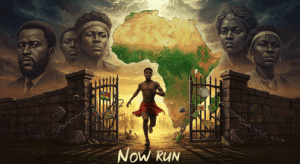
The house is still bugged. The leash is still tight. But the door? The door is open.
Now run.