
Introduction
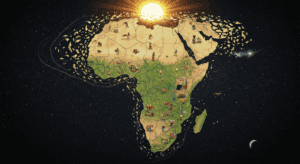
At the Berlin Conference of 1884–85, European colonial powers carved the African continent into territories to serve imperial interests, entirely disregarding the cultural, ethnic, linguistic, and historical landscapes of the indigenous peoples. These arbitrary borders were drawn with rulers and ink, not with consent or context, and with no African representation at the table. The long shadow of that colonial cartography continues to loom over the continent, manifesting in interethnic conflict, political instability, economic fragmentation, and the thwarting of Pan-African unity. This essay explores the enduring consequences of these boundaries and the deep structural damage they have inflicted on African societies.
1. Ethnic Conflict and Division
One of the most immediate and visible impacts of arbitrary colonial borders has been the eruption of ethnic conflict. Traditional African communities that had coexisted, traded, or fought according to regional norms were suddenly divided across multiple new colonial borders. Others were thrust into the same artificial political entities despite longstanding rivalries or cultural differences.
For example, the Somali people were divided among five different countries: Somalia, Ethiopia, Kenya, Djibouti, and Eritrea. This fragmentation fueled decades of irredentist conflict and tension. Similarly, Nigeria’s more than 250 ethnic groups were lumped together, sowing the seeds for the Biafran War (1967–1970), where the Igbo population sought to secede due to perceived marginalization by the central government dominated by other ethnic groups.
In Rwanda, colonial manipulation of Hutu and Tutsi identities under an imposed Belgian regime laid the foundation for one of the 20th century’s worst genocides. In these and many other cases, the European-imposed map created societies rife with suspicion, tribalism, and conflict.
2. Political Instability and Fragile States
The borders drawn by colonial powers created states that lacked internal cohesion and legitimacy. These new states were often governed by elites handpicked or favored by the colonizers, lacking any organic relationship with the people they ruled. As a result, many African states emerged from independence already burdened by mistrust, weak institutions, and centralized governments ill-suited to the continent’s diverse realities.
The Democratic Republic of Congo serves as a sobering example. Once ruled as the personal property of King Leopold II of Belgium, the country was granted independence in 1960 with virtually no preparation for self-governance. Within months, political chaos erupted. Over the decades, coups, civil wars, and foreign interventions have plagued the nation, a direct consequence of colonial borders that ignored natural political and social formations.
In Sudan, the imposition of a single state uniting the Muslim Arab North with the predominantly Christian and animist South led to prolonged civil wars and ultimately the secession of South Sudan in 2011. Even then, the new borders did not resolve underlying tensions.
3. Economic Dysfunction and Disintegration
Colonial boundaries were also economic borders, designed to facilitate resource extraction and trade with Europe rather than regional integration. Natural economic zones were fragmented, historical trade routes severed, and local industries subordinated to European markets. This design has perpetuated a structural dependency on foreign economies that continues today.
The arbitrary map led to bizarre outcomes, such as landlocked countries like Mali, Niger, and Chad being separated from coastal access, forcing them to rely on politically volatile neighbors for trade. Intra-African trade remains minimal—less than 20% of total trade compared to over 60% in the European Union—because colonial borders still define African commerce.
Efforts like the African Continental Free Trade Area (AfCFTA) are attempting to reverse this legacy, but the scale of the task is immense, and the ghost of arbitrary cartography remains stubbornly present.
4. The Obstruction of Pan-Africanism
Arbitrary colonial boundaries have also been a major impediment to the Pan-African vision. Leaders like Kwame Nkrumah, Julius Nyerere, and Patrice Lumumba envisioned a united Africa that could speak with one voice on the global stage. But national borders, loyalties, and identities imposed by colonizers proved difficult to transcend.
In 1964, the Organization of African Unity adopted the principle of uti possidetis juris, deciding to respect colonial borders in order to prevent border wars. Though politically pragmatic, this decision enshrined the colonial legacy as a permanent feature of African political geography. It locked Africa into a structure defined by external powers, making true unity aspirational rather than actionable.
The psychological effects are profound. Instead of seeing themselves as Africans first, many people identify as nationals of artificial states, perpetuating division and hindering solidarity. A continent that was once a mosaic of interconnected societies was atomized into fragments.
Conclusion
The problems caused by the arbitrary boundaries drawn in Africa are not relics of the past—they are ongoing crises. Ethnic violence, political fragmentation, economic dependency, and cultural dislocation all stem from lines drawn without wisdom, sensitivity, or legitimacy. These imposed borders have created fragile states and fractured communities, and their impact cannot be erased simply by declaring independence or renaming a capital city.
However, Africa does not need to redraw the map to reclaim its future. It needs to redraw its imagination. By investing in regional integration, rebuilding indigenous governance structures, reasserting African-centered education, and reviving intra-African solidarity, the continent can transcend the legacy of the colonial cartographers. These borders may have been imposed, but the destiny of Africa remains a matter of conscious choice.