
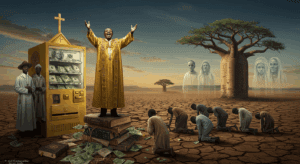
There was no earthquake. No lightning struck when the gavel fell on Patricia Asiedua, alias Nana Agradaa, sentencing her to 15 years in prison for fraud and “charlatanic advertisement.” But the silence was thunderous. For millions across Ghana and the diaspora, it was not merely a conviction. It was a mirror, lifted high, exposing the grotesque theater that modern African Christianity has become in the wake of colonial conquest.
Agradaa is not exceptional. She is the logical conclusion of a distorted spiritual economy. The churches that birthed her—whether Pentecostal, prophetic, or pseudo-traditional—are not aberrations. They are part of a long arc of spiritual dispossession that began with colonization and now continues, not through European priests, but through African prophets wearing Italian suits and wielding scripture as sorcery. To critique Agradaa alone is to misunderstand the structure. This is not about one woman’s moral failings. This is about the collapse of spiritual sovereignty in postcolonial Africa. It is about how colonial Christianity laid waste to indigenous cosmologies and how, in that wreckage, a new class of spiritual entrepreneurs emerged—offering salvation for sale.
The arrival of European Christianity in Africa was never merely religious. It was an imperial technology, engineered to pacify, recondition, and spiritually disarm entire societies. The Bible was not a book of liberation but a contract of submission. Indigenous African religions—rooted in community, ecology, reciprocity, and sacred time—were demonized, their oracles silenced, their priests discredited. The missionaries did not come alone. They came with guns, grammars, and Bibles, three pillars of epistemic conquest. Colonial Christianity did not merely convert Africans to a new God. It amputated their cultural memory, replacing ancestral wisdom with imported theology that sanctified obedience, condemned resistance, and offered heaven as a reward for earthly subjugation. Out of this scorched terrain, a vacuum was born. And nature, as it always does, abhors a vacuum.
The African Independent Churches, the Pentecostal wave, the rise of the prosperity gospel—these were not mere revivals. They were mutations. In the ruins of colonial faith, a new theological economy arose—one that fused capitalism with charisma, spectacle with scripture. Enter the Agradaa archetype. Here, faith is not a communal covenant but a personal transaction. Here, God is not the Source but a celestial vending machine, to whom one sows in cash to reap in cars, visas, wombs, or wealth. In this twisted cosmology, suffering is a sign of spiritual laziness, and poverty is not systemic but personal—a punishment for not tithing enough. This theology did not emerge from African metaphysics. It is a neoliberal permutation, imported from American televangelism, draped in African aesthetics, and animated by desperation.
How does one explain the crowd—intelligent, aspirational, prayerful men and women—lining up to be defrauded? Because trauma distorts discernment. Because colonialism not only stole land but also rewired our relationship to the divine. Once, the gods dwelt in rivers, forests, and shrines. Now, they broadcast on Facebook Live, demand mobile money transfers, and threaten misfortune to non-givers. This is not stupidity. It is the psychological inheritance of disempowerment. A population abandoned by economic systems, betrayed by political elites, and exhausted by social decay seeks miracles as a last resort. Where there is pain, there is a prophet. Where there is hunger, there is always a man with a Bible and a scheme.
The Ghanaian judiciary, by sentencing Agradaa, has made a bold assertion: religion is not above the law. But law alone is not salvation. Courts can punish the symptom, but only cultural and intellectual emancipation can cure the disease. What of the thousands who imitate her, less visible but equally manipulative? What of the regulatory bodies that slumber as tithes are extorted and hope commodified? Until we decolonize the religious imagination, until we restore spiritual literacy grounded in both ancestral wisdom and critical modernity, the fraud will persist. It will change faces. It will adopt new slogans. But it will thrive.
The time has come for a new African theology, one that is not imported, not predatory, not submissive. We must reclaim spiritual sovereignty as a birthright of the African consciousness. This means restoring indigenous cosmologies, not as museum artifacts, but as living spiritual grammars. It means reclaiming the divine as communal, not transactional. It means teaching discernment, critical thinking, and historical memory in churches and schools. It means separating faith from greed, and spirituality from spectacle. This is not a war on Christianity. It is a war on its colonial mutation. It is a call for a radical re-Africanization of the divine.
The Agradaa case is not the end. It is a beginning—a moment of rupture that should trigger reflection, resistance, and reconstruction. We must ask: What kind of God do we serve when the poor must pay for miracles? What kind of theology thrives on fear, guilt, and manipulation? What does liberation mean when our pulpits have become platforms for economic extraction? The answers will not come from courts alone. They must come from us—the thinkers, the teachers, the truth-tellers, the spiritual rebels. The ones who refuse to confuse faith with foolishness.
God is not a vending machine. And Africa is not a market for salvation. It is time to reclaim the sacred, from the frauds and the pharaohs alike.