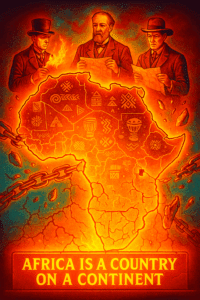
To begin with a provocation: Africa is not a continent in the conventional sense—it is a country scattered across a vast continental landscape. This formulation, intentionally paradoxical, challenges the mental cartography inherited from colonialism and still imprinted on post-independence political discourse. It asserts not geography, but destiny: a destiny betrayed by borders, bureaucracies, and balkanization.
What if we abandoned the colonial fiction of 54 nations and reclaimed the civilizational unity that preceded colonial fragmentation? What if, instead of defending these artificially imposed nation-states, we reimagined Africa as one country in chains—chains forged at Berlin and fastened by the enduring structures of neocolonial control, comprador elites, and global capital?
This is not mere poetic license. It is political realism. The boundaries that divide Africa are not the product of natural geography or organic cultural divergence. They are the result of violent conferences, imperial maps, and the insatiable appetite of empires. The 1884–85 Berlin Conference, where Africa was divided without a single African present, marked the beginning of a profound ontological dismemberment. Ancient empires such as Mali, Songhai, Kemet, Kush, Great Zimbabwe, and the Oyo Kingdom once formed extensive networks of governance, trade, and knowledge. These were not “countries” in the European sense, but cultural-political zones with coherent cosmologies and a sense of belonging.
The colonial state introduced the myth of the nation-state to Africa—often with no regard for language, kinship, culture, or history. The new states were colonial constructs, designed for administration and extraction, not unity or empowerment. Post-independence governments inherited these maps and myths. Their task was not to decolonize geography but to manage fragmentation. Consequently, Pan-Africanism—once a radical call for continental unification—was reduced to a rhetorical gesture, celebrated in summits but abandoned in practice.
Africa is a country in chains because it is treated as such by global capital. Western corporations negotiate not with sovereign equals but with weak state actors who often speak for themselves more than their people. Mineral wealth flows outward while dependency deepens. International institutions design policies not to empower Africa as a whole, but to control its fragmented parts. In trade, in finance, in security, Africa remains one country in the eyes of the global north—but a dismembered one, deliberately prevented from integrating.
The African Union, despite its aspirations, lacks the supranational authority to override the sovereignty of individual states. ECOWAS, SADC, and EAC serve useful regional roles but are rarely harmonized. The dream of a single African currency, passport, army, or parliament remains deferred—not for lack of desire, but because national elites benefit from the current disorder.
But the idea of Africa as one country is not dead. It lives in the hearts of its people. African youth, increasingly connected by technology, culture, and shared struggle, often feel more Pan-African than their leaders. Music crosses borders more easily than visas. Ideas flow more rapidly than policies. The continent’s diasporic networks—especially in Brazil, the Caribbean, Europe, and North America—are beginning to speak a common language of return, resistance, and renaissance.
To affirm that “Africa is a country on a continent” is to propose a philosophical, cultural, and political reorientation. It is to demand the dismantling of the Berlin logic and the resurrection of an African logic. It is to say that until Africa acts as one, it will be acted upon. Until it speaks with one voice, it will be spoken for. Until it unites, it will be used.
This is the mission of PowerAfrika: not merely to critique, but to construct. Not merely to remember the past, but to rewrite the future. Our task is not to replicate Western models but to return to African principles of unity, reciprocity, and wholeness—principles that existed long before the map was carved.
Africa is a country. Not metaphorically, but ontologically. It is a country yet to be born, but already alive in the spirit of its people.