Opening Reflection
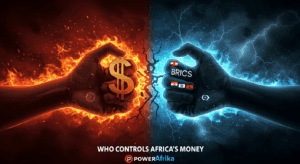
At the heart of Africa’s economic entrapment lies a profound contradiction: a continent so rich in resources, talent, and cultural ingenuity, yet operating without a sovereign monetary system that reflects its values, aspirations, or autonomy. For decades, the U.S. dollar has been the instrument of global trade and reserve power, shaping not only the terms of Africa’s participation in world markets but also the terms of its subjugation. Now, a new challenger emerges: the BRICS alliance, proposing alternatives to dollar hegemony. But should Africa rejoice at this so-called “multipolarity,” or are we merely choosing a new master in place of the old?
The Dollar’s Grip: A Colonial Legacy in Disguise
The dominance of the U.S. dollar is not merely an economic convenience; it is a political imposition wrapped in the veneer of global consensus. Born from the ashes of World War II and cemented at Bretton Woods, the dollar became the default standard for oil trade, international debt, and global liquidity. This alignment created structural dependencies, whereby African states had to borrow in dollars, trade in dollars, and price their resources in dollars, despite producing none of it themselves.
This system consolidates economic control in Washington and Wall Street while masking the inherent inequities behind a facade of efficiency and stability. African economies, left to float in the wake of dollar volatility and U.S. Federal Reserve policy shifts, suffer inflation, debt spirals, and austerity—none of which they control.
BRICS: A Multipolar Promise or Strategic Mirage?
Into this imbalance steps the BRICS bloc (Brazil, Russia, India, China, South Africa), with promises of a new global currency, a development bank, and a trade order less reliant on Western dictates. Superficially, this seems a welcome disruption. It appeals to many African leaders as a counterweight to U.S. domination and IMF conditionalities.
Yet beneath the rhetoric of partnership lies a less noble truth. The BRICS are not anti-imperialists—they are emerging imperialists. China and Russia, in particular, seek to reconfigure global influence in their favor. Africa’s experience with Chinese infrastructure deals and resource-for-loan arrangements has already revealed neocolonial undertones. Moreover, the proposed BRICS currency—still undeveloped—remains contingent on political cohesion that the bloc currently lacks.
Thus, while BRICS may weaken U.S. control, it does not dismantle the architecture of economic dependency. It replaces one currency oligarchy with another, while Africa remains a passive participant, not an agenda-setter.
Currency Sovereignty: The Missing Link in African Liberation
The central dilemma is not whether the dollar or the yuan should dominate but why Africa must trade value through systems it did not design. The deeper crisis is not monetary—it is philosophical. Until African nations conceptualize money as a tool of sovereign will, they will always be spectators in the theater of global capital.
What would currency sovereignty look like? It may begin with a Pan-African digital currency, backed not by fiat or foreign reserves but by Africa’s abundant resources—gold, rare earth minerals, agricultural surpluses. It must also be embedded in cultural values: communalism, reciprocity, and resilience. Such a currency would not merely facilitate trade; it would symbolize psychological emancipation and economic interdependence on our own terms.
Between Empires: The Urgency of Strategic Non-Alignment
The temptation to align with BRICS stems from the legitimate exhaustion with Western hypocrisy. But reaction is not revolution. Africa must avoid the trap of binary thinking: the idea that salvation lies in choosing between competing global powers. Instead, this is the moment to forge a third path—a doctrine of strategic non-alignment that reclaims agency and reinvents global engagement.
Strategic non-alignment is not neutrality; it is leverage. It requires the creation of continental institutions, regulatory coherence, and above all, a psychological reorientation—a belief that Africa deserves to be the mint of its own destiny.
Conclusion: The Price of Money is Memory
Africa’s monetary future will not be determined by the elegance of financial models but by the courage to break historical habits. The dollar haunts us like a ghost of colonial fiat, while BRICS beckons with seductive promises veiled in strategic self-interest. Until Africa resolves to define value in African terms, to circulate currency that embodies African worth, we will remain rich in soil but poor in sovereignty.
In this transitional age, PowerAfrika must speak not just of economics, but of emancipation. The true revolution lies not in the coin we use, but in reclaiming the authority to decide what that coin means.