
By PowerAfrika
“To imagine is to resist. To remember is to build. Sankocracy is not a theory for the ivory tower. It is a call from the ancestors, a design from the people, and a prophecy for Africa’s political rebirth.”
I. The Colonial Inheritance of the African Mind
Africa did not just inherit colonial borders. It inherited a political imagination shaped by empire. The state, the ballot, the parliament — these were not born of our cosmologies, our kinship systems, or our sacred knowledge traditions. They were imposed as universal, masquerading as modern. But beneath their democratic veneer lies an architecture of control: an imported system that taught us to equate governance with elections, freedom with Western institutions, and legitimacy with external validation.
From Accra to Algiers, the post-independence state resembled its colonial predecessor: extractive, centralized, and alienated from the people it claimed to serve. It wore African names but spoke in European tongues. The ballot replaced the bayonet, but the violence of exclusion, exploitation, and elite capture persisted.
II. The Bankruptcy of Electoral Redemption
Across the continent, elections have become rituals of false hope. They rotate elites without transforming systems. They manufacture legitimacy without delivering justice. They channel popular energy into ballots, only to siphon it away from real structural change. The idea that voting every four or five years constitutes participation is not just inadequate — it is a deception.
We do not reject democracy because we despise freedom. We reject its imported form because it was never tailored for our reality. What we seek is not silence, but sovereignty. Not electoral theatrics, but ethical stewardship.
III. Sankocracy: Memory as Method, Sovereignty as Soul
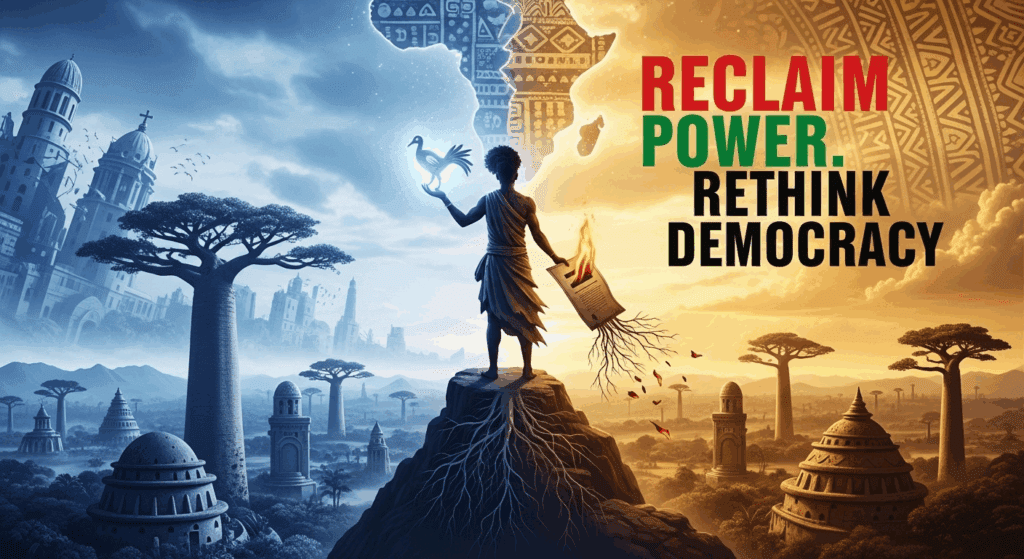
Enter Sankocracy — not as utopia, but as a grounded African theory of governance rooted in memory, responsibility, and regenerative power. The term fuses Sankofa, the Akan concept of returning to fetch what was lost, with kratos, the Greek root for power. It is the act of looking back to move forward, of reclaiming ancestral governance to forge postcolonial futures.
Sankocracy is animated by four cardinal pillars:
-
Continuity of Leadership: Not dynastic rule, but wisdom-based transition. Eldership, mentorship, and lineage stewardship replace term limits and populist cycles.
-
Ethical Meritocracy: Authority flows not from votes alone, but from demonstrated service, sacrifice, and spiritual maturity.
-
Communal Subsidiarity: Decision-making begins where people live — in villages, towns, collectives — and only moves upward if necessary. This is the inverse of top-down rule.
-
Sovereign Memory: History is not backdrop but blueprint. Oral traditions, sacred law, and indigenous knowledge are constitutional, not ceremonial.
Sankocracy rejects authoritarianism and electoralism alike. It is deeply participatory but not procedural. It is consultative, spiritual, and bound to land, lineage, and moral obligation.
IV. Reimagining Governance as Cultural Practice
Under Sankocracy, governance is not technocratic. It is cultural. Leadership is not careerist. It is custodial. Power is not held. It is rotated, remembered, and returned.
Our ancestors governed without prisons, parliaments, or political parties — not because they lacked intelligence, but because they understood community. They practiced palaver, not propaganda. They resolved conflict in circles, not chambers. They served, not ruled.
Sankocracy retrieves these indigenous logics and retools them for our era — not as nostalgia, but as necessity. In a world collapsing under neoliberalism, climate chaos, and democratic fatigue, Africa does not need to catch up. It needs to catch fire.
V. Towards a Post-Colonial Political Vocabulary
Sankocracy is more than critique. It is creation. It is not reactionary; it is revolutionary. It demands that we no longer ask how to fix democracy in Africa but rather how to replace it with something ours — something rooted, resilient, and re-enchanted.
To speak of Sankocracy is to name the unnamed: the longing of a people not simply to vote, but to belong — to a system that sees them, reflects them, and evolves with them.
VI. PowerAfrika’s Mandate: Incubating the New
At PowerAfrika, we do not traffic in abstraction. We curate futures. Through essays, media, assemblies, and digital movements, we are seeding the discourse of Sankocracy, stirring the cracks in the colonial consensus, and systematizing a new model of African governance.
The political imagination is our last frontier. And in reclaiming it, we reclaim everything else.