
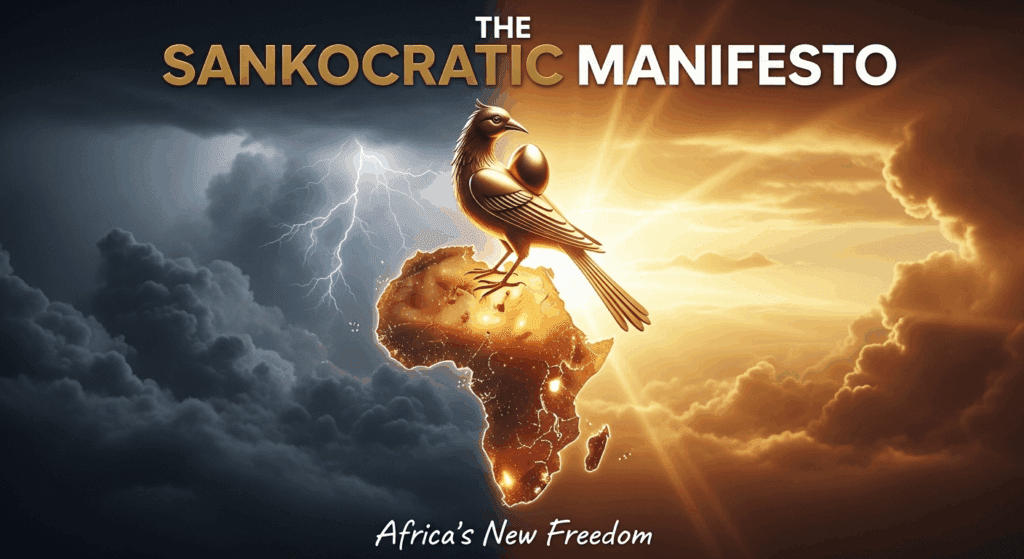
The Constitution of African Sovereignty through Memory, Culture, and Communal Power
Adopted by the PowerAfrika Movement
Preamble
We, the inheritors of Africa’s ancient wisdom and the survivors of its deepest wounds, declare the birth of Sankocracy: a governance rooted in Sankofa—the sacred principle that we must retrieve what was stolen, distorted, or forgotten in order to build a just future.
We reject governance systems that reduce freedom to a performance, democracy to an illusion, and sovereignty to a slogan. We affirm that no foreign blueprint, whether liberal parliamentarianism, presidential autocracy, or corporate technocracy, can represent the African soul or safeguard African destiny.
We proclaim that true governance must grow from the soil of our memory, the dignity of our cultures, and the unity of our peoples.
I. Philosophical Foundation
1. The Principle of Sankofa:
Governance begins with the reclamation of our history, languages, philosophies, and spiritual traditions. We cannot chart a sovereign future without returning to the ancestral well for truth.
2. The Communal Ethic:
The individual exists within the community, and the community exists to protect the dignity of the individual. This is the essence of Ubuntu—“I am because we are”—applied to the architecture of power.
3. The Integrity of Choice:
No choice is free if it is made under fear, ignorance, or dependency. Sankocracy is committed to dismantling the “engineered consequences” that bind African agency—whether economic, political, psychological, or spiritual.
II. Political Doctrine
-
Governance by the Remembering Community:
Power shall rest in assemblies rooted in local consensus and cultural legitimacy, not imported institutions. Elders, youth, and women must be equally represented as custodians of communal wisdom. -
Sovereignty of Resources:
All land, water, minerals, and critical infrastructure are collective assets. They cannot be sold, mortgaged, or leased to foreign powers without the direct consent of the people. -
Narrative Autonomy:
Education, media, and cultural production must serve the truth of African history and aspirations. Foreign narratives designed to pacify or infantilize African peoples are to be actively dismantled. -
Economic Self-Determination:
Development must be self-directed, rejecting debt traps and aid dependency. Local production, cooperative ownership, and intra-African trade are the pillars of prosperity.
III. Social Doctrine
-
Restorative Justice:
Justice must heal rather than merely punish. Systems of accountability should restore relationships and repair the moral fabric of society. -
Guardianship of Memory:
National archives, monuments, and oral histories are sacred trusts. Forgetting is treason against future generations. -
Gender and Generational Balance:
Sankocracy rejects the marginalization of women and youth as a colonial inheritance. Governance must draw equally from all sources of wisdom.
IV. Spiritual Doctrine
-
Freedom of Belief with Cultural Integrity:
Every African has the right to worship or not worship, but no faith system may denigrate or erase indigenous spiritual traditions. -
Sacred Stewardship of Nature:
The land is a living ancestor. Exploitation that desecrates its balance is forbidden, for ecological collapse is a form of generational theft.
V. Strategic Imperatives
-
Dismantling the Economy of Fear:
We will replace punitive consequence systems with structures of trust, solidarity, and mutual protection. -
Building Immunity to Re-Colonization:
Political and economic independence must be reinforced by narrative sovereignty, cultural pride, and technological self-reliance. -
Continental Unity through Diversity:
Sankocracy is not tribalism, nor is it homogenization. It is the federation of Africa’s diverse civilizations into a shared shield against exploitation.
VI. The Sankocratic Oath
We vow to remember.
We vow to resist.
We vow to build a future where Africa governs herself—not in imitation, but in integrity.
We vow that our freedom will not be granted, bought, or borrowed—it will be forged in the image of our ancestors and safeguarded for our descendants.
VII. Call to Action
Sankocracy begins where submission ends. It lives in the village council that refuses corporate land grabs, in the classroom where colonial lies are dismantled, in the marketplace where African-made goods replace imports, in the mind that will not bow to fear.
The prison of the mind is the final frontier of African liberation. We call upon every African, at home and abroad, to rise—not as subjects of a state, but as custodians of a civilization.
Signed in the spirit of Sankofa,
Under the authority of the PowerAfrika Movement