Introduction:
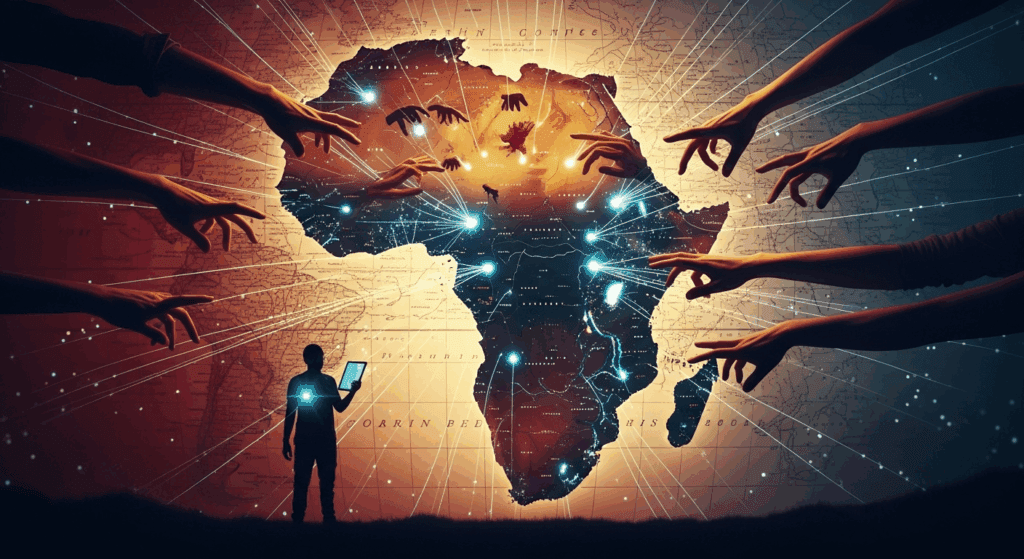
“In 1884, European kings and generals sat in Berlin, not to debate human dignity, but to carve Africa like a cake—land was divided, peoples were split, sovereignty was stolen. Borders were drawn with rulers; lives were erased with ink. Today, a new conference unfolds—but the hall is virtual, the pens are code, and the rulers are tech monopolies and venture capitalists. The battlefield is invisible, composed of fiber-optic cables, cloud servers, and algorithmic intelligence. And once again, Africa is being carved—bit by byte, algorithm by algorithm, user by user.”
Framing the Argument :
Then, land was the resource. Africans were suppliers of raw materials, labor, and markets for European powers. Now, data is the resource, and the story repeats in a digital guise. Africans generate billions of digital footprints daily—social interactions, biometric identifiers, financial transactions, cultural production—but they remain excluded from ownership of the platforms, the infrastructure, and the profits. The extraction is subtle, hidden in interfaces and user agreements, but it is no less a continuation of the same logic of dispossession.
Historical Analogy: Berlin → Big Tech:
The Berlin Conference institutionalized European dominance over Africa through legal fiat. Today, Meta, Google, Huawei, Starlink, and Amazon Web Services act as the new colonial governors. Africa’s digital borders are drawn in Silicon Valley boardrooms, Shenzhen server factories, and London financial centers. The map may look different, but the dynamics are the same: control of the resource, control of the people, and the illusion of free choice. Africans are participants in a system they neither govern nor profit from—an invisible dependency that mirrors the railroads, ports, and mines of the 19th century.
Dependency & Vulnerability:
-
Over 70% of African internet traffic routes through Europe or the United States before reaching another African nation. This is not merely inefficiency; it is strategic dependency, designed and maintained by the same structural logic that once ensured that raw materials could only be exported to foreign markets.
-
African startups struggle to compete against platforms built, funded, and scaled abroad. Every click, swipe, and transaction enriches corporations that do not answer to African citizens, yet dictate the flow of information, commerce, and knowledge.
Economic Extraction & Sovereignty Crisis:
Tech monopolies extract billions annually from African digital activity: advertising, cloud services, digital payments, app subscriptions. Africans produce the data, but the value accrues elsewhere. Whoever controls the cables, servers, satellites, and platforms exercises de facto governance over Africa’s digital and economic future. This is sovereignty stripped of visibility—subtle, seductive, and systemic.
Cultural & Civilizational Dimensions:
This is not just economics; it is a cultural siege. Digital colonization shapes African narratives, behaviors, and consciousness. Algorithms trained on African data decide which content trends, which voices amplify, and which knowledge is deemed legitimate. Africa’s self-perception is filtered through foreign code. The stakes are civilizational: control the digital infrastructure, and you control the narrative, the economy, and the imagination of a continent.
Call to Action / Path to Digital Sovereignty:
Africa must not reject technology—it must reclaim it. The strategy is clear:
-
Infrastructure: Build African-owned undersea cables, cloud networks, satellites, and server farms. Stop sending our data across foreign soil to enrich others.
-
Platforms: Develop homegrown social media, fintech, AI, and communication platforms that prioritize African agency, governance, and profit retention.
-
Policy: Enact enforceable data protection and digital sovereignty laws that safeguard citizens and ensure local value capture.
-
Pan-African Currency: Establish a continental digital currency to reclaim transactional power, facilitate cross-border trade, and secure economic autonomy.
The mission is urgent. Africa’s digital independence is not theoretical; it is existential. The continent has the intellect, resources, and youth capacity to build a sovereign digital ecosystem. The question is no longer whether we can participate, but whether we will own, design, and govern the technologies that shape our destiny.
Closing Punch:
The Berlin Conference was a lesson in dispossession, enforced by gunboats and diplomatic legerdemain. Today, Africa faces an equally potent but invisible colonization, enforced by algorithms, corporate policy, and foreign infrastructure. The digital domain is the new battlefield for African sovereignty, and the time to act is now. Will Africa remain a raw material supplier in the digital age, or will it forge a self-determined technological destiny that matches its civilizational greatness? The choice is ours—but only if we summon the vision, strategy, and audacity to seize it.