Because the African Union has declared 2025 the Year of Justice for Africans and People of African Descent Through Reparations, and for once, words must become structures, plans, funds, laws. Because if we do not demand, nothing will be given. Power only concedes to power, and justice is never voluntary—this essay is written.
There is a story Africa has not been allowed to tell itself. It begins not in chains, but in wealth—gold in the soil of Mali, libraries in Timbuktu, kingdoms that traded across oceans, artisans whose hands shaped bronze, ivory, and cloth that dazzled the world. Then came the rupture: ships arriving like vultures, carrying crosses in one hand and chains in the other. What followed was not a migration, not an exchange, but the greatest crime humanity has ever known—the theft of people, of land, of knowledge, of dignity. The world was rebuilt on Africa’s broken back, and yet Africa was told to be silent.
For four centuries, millions were stolen, forced into plantations from Jamaica to Virginia. Their sweat watered foreign soil, their blood fertilized economies that became empires. When Britain abolished slavery in 1833, who was paid? Not the enslaved. Not the mothers torn from their children, not the men whose names were erased. Instead, it was the slave owners—paid twenty million pounds, an astronomical sum then, to compensate them for the “loss of property.” The enslaved themselves received nothing. Britain’s taxpayers, including the descendants of those once enslaved, only finished repaying that debt in 2015. Imagine the obscenity: descendants of slaves paying, through taxes, for the freedom their ancestors were denied.
This is the hidden story: the wealth of Europe and America is stained with African labor, and yet when Africa asked for justice, it was told to “forget,” to “move on,” to “develop itself.” But how do you develop on stolen ground? How do you run a race when your starting line was pushed back centuries, while others sprinted ahead carrying your stolen inheritance? Reparations are not charity, not aid, not a favor. Reparations are the settling of an unpaid bill, the restoration of stolen time, the recognition that the past did not vanish—it still bleeds into the present.
Look around Africa today and you see the fingerprints of the crime. Artificial borders carved by colonial rulers, still fueling conflict. Economies tied to raw material exports, a colonial design never dismantled. Debt that should never have existed, extracted by institutions born in the very capitals that profited from slavery. Youth unemployed not because they lack genius, but because systems were rigged to keep Africa as supplier, never owner. The plunder did not end in 1960 with independence; it evolved. It changed uniforms but kept the same command.
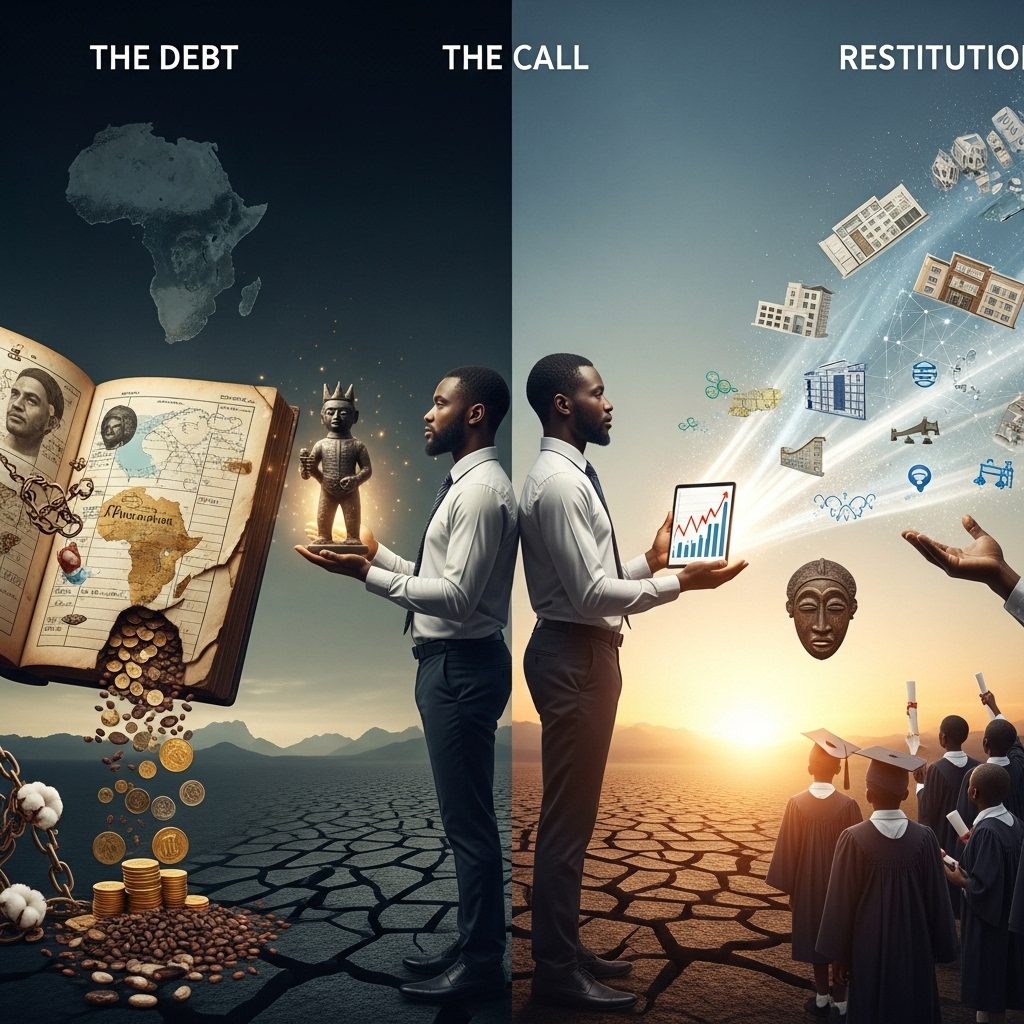
The case for reparations is therefore simple: Africa has given without consent, bled without recognition, labored without pay. Every European palace, every Western bank, every university built on endowments from sugar, cotton, tobacco, or gold owes a debt. Every museum holding Benin bronzes, Ethiopian manuscripts, or the bones of African ancestors is a warehouse of stolen memory. Every multinational mining cobalt in Congo while children dig with bare hands continues the crime. This is not about the past; it is about the continuity of plunder into the present.
The beneficiaries must be named: Britain, France, Belgium, Portugal, Spain, the Netherlands, Germany, Italy, the United States, corporations, banks, churches. They orchestrated, funded, and profited. The charges are clear:
– Unpaid wages for centuries of forced labor.
– Stolen land and resources, ripped from Africa without consent.
– Cultural genocide, erasing languages, religions, histories.
– Crimes against humanity, in the millions of lives enslaved, murdered, dehumanized.
– Ongoing exploitation, neo-colonial systems that keep the continent shackled in debt and dependency.
Reparations must therefore be comprehensive. Money, yes—but money alone is insufficient. There must be cancellation of illegitimate debts, restitution of stolen artefacts, investment in African education, technology, and healthcare. There must be symbolic reckoning—apologies, memorials, truth commissions—but also structural reforms in global trade, resource sovereignty, and cultural restitution. Reparations must heal both the wound in the soil and the wound in the soul.
Why now? Because silence has lasted too long. Because Africa’s youth are no longer content with half-truths. Because even the former slave-owning families in Europe now admit what was done, while African governments begin to stand taller. Because the African Union has raised the banner, and this generation must march under it. Because if we do not demand, nothing will be given.
Let the record show: Africa does not beg. Africa demands. We demand repayment of a debt written in centuries of unpaid labor, in artifacts sitting in European glass cases, in the lives cut short and the futures denied. The youth of Africa must know this hidden story, because their liberation depends on truth. To remain silent is to live in chains invisible but unbroken. To rise, to demand reparations, is to declare: the crime will not be buried, and the bill will not be forgotten.
Reparations are not the end of struggle, but the beginning of repair. They are the bridge between the dignity of our ancestors and the future of our children. The time has come to collect.