Editor’s Note:

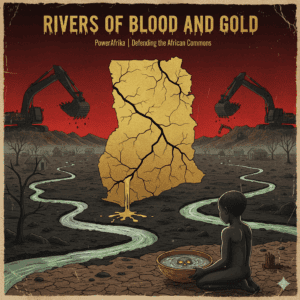
This second installment continues PowerAfrika’s legal and moral indictment of Ghana’s resource mismanagement. It focuses on the environmental devastation wrought by illegal and state-enabled mining—known locally as galamsey—and the ensuing collapse of Ghana’s ecological, social, and moral order.
By the Office of the Chief Counsel, PowerAfrika
There is a proverb among the Akan: “When the last tree dies, the last man dies.” It was not meant as poetry—it was prophecy. Today, Ghana stands at the threshold of that prophecy’s fulfillment.
Her rivers, once pure arteries of life, now flow thick with mercury and cyanide. Her forests, once the lungs of the continent, are gasping for breath. The cry of the land is no longer symbolic—it is audible, chemical, measurable.
The Anatomy of a Dying Land
According to recent data from Ghana’s Water Resources Commission, more than 60% of Ghana’s major rivers are polluted beyond human use. The Pra, the Offin, the Ankobra, and the Birim—once sacred, now poisoned—bear witness to a collective failure. Satellite imagery from the Center for Remote Sensing and Geographic Information Services (CERSGIS) at the University of Ghana reveals that illegal mining has stripped over 4,500 square kilometers of forest cover in the last two decades.
Yet the state continues to grant mining leases, while simultaneously declaring war on illegal miners. This hypocrisy is the hallmark of Ghana’s governance crisis: the law is enforced against the poor, but negotiated with the powerful.
The Science of Poison
Galamsey is not merely a social vice—it is a biochemical weapon unleashed upon the nation’s own bloodstream. Mercury and cyanide, used in small-scale gold extraction, seep into rivers and groundwater, bioaccumulating in fish and crops. Studies by the Ghana Environmental Protection Agency show that mercury levels in the Pra River exceed safe limits by more than 200%.
The result: birth defects, neurological damage, kidney failure, and slow death—especially among the poor who depend on these waters for survival. Ghana is poisoning her children to enrich her elites.
The Political Economy of Decay
The government’s complicity is not accidental; it is systemic. Many galamsey operations are directly or indirectly linked to political financiers, traditional authorities, and even security agencies. The Minerals and Mining Act, which centralizes resource control in the presidency, creates fertile ground for impunity.
Here lies the moral contradiction: the state that criminalizes small-scale miners in Dunkwa or Tarkwa is the same state that issues “special permits” to politically connected businessmen to mine in protected forest reserves.
Thus, Ghana’s environmental crisis is not a failure of enforcement—it is a failure of integrity.
Spiritual and Psychological Corruption
No nation can destroy its rivers without first corrupting its soul. The galamsey phenomenon reveals a deeper pathology—a kind of moral dissociation where personal gain trumps collective survival.
Traditional taboos once forbade defiling rivers and sacred groves. Now, pastors bless excavators, chiefs lease ancestral lands, and politicians baptize destruction in the language of development. This is not modernization—it is apostasy.
The Ghanaian psyche has been conditioned to equate wealth with wisdom, and speed with progress. But what is wealth if the people drink poison? What is progress if children bathe in mercury?
A Nation Without Water
The Ghana Water Company has already sounded the alarm: within a decade, major urban centers could face complete water scarcity. The irony is cruel—the nation that calls herself the “Gateway to Africa” may soon have to import water.
This is not an exaggeration; it is a projection. Unless radical intervention occurs, Ghana’s freshwater systems will collapse within 15–20 years.
The Legal and Moral Indictment
By permitting this ecological carnage, the Ghanaian state has violated:
-
Article 36(9) of the Constitution: the duty to protect the environment for posterity.
-
Article 257(6): the fiduciary obligation to hold resources in trust for the people.
-
Natural Law itself, which forbids the destruction of life-sustaining ecosystems.
In legal language, this is reckless endangerment on a national scale. In moral language, it is ecocide.
PowerAfrika’s Position
PowerAfrika hereby declares galamsey not merely illegal but illegitimate, and the government of Ghana culpably negligent for failing to stop it.
We demand:
-
Immediate suspension of all mining in or near major river systems.
-
A full public inquiry into political complicity in illegal mining.
-
The establishment of an Ecological Reparations Fund, financed by all companies and individuals found to have profited from environmental destruction.
-
Criminal prosecution of public officials and corporate actors complicit in galamsey operations.
Epilogue: The Mirror and the Warning
Galamsey is not simply an economic crime—it is a mirror held up to the nation’s soul. Ghana must look into that mirror and confront what she has become: a people trading tomorrow for today.
If this madness continues, there will come a day when the people will walk to their rivers and find no reflection—only mud, only silence.
On that day, Ghana will understand too late that gold cannot quench thirst.
PowerAfrika | Defending the African Commons
“We speak for the rivers, the forests, and the unborn.”