I. Prologue: The Brown River’s Testimony
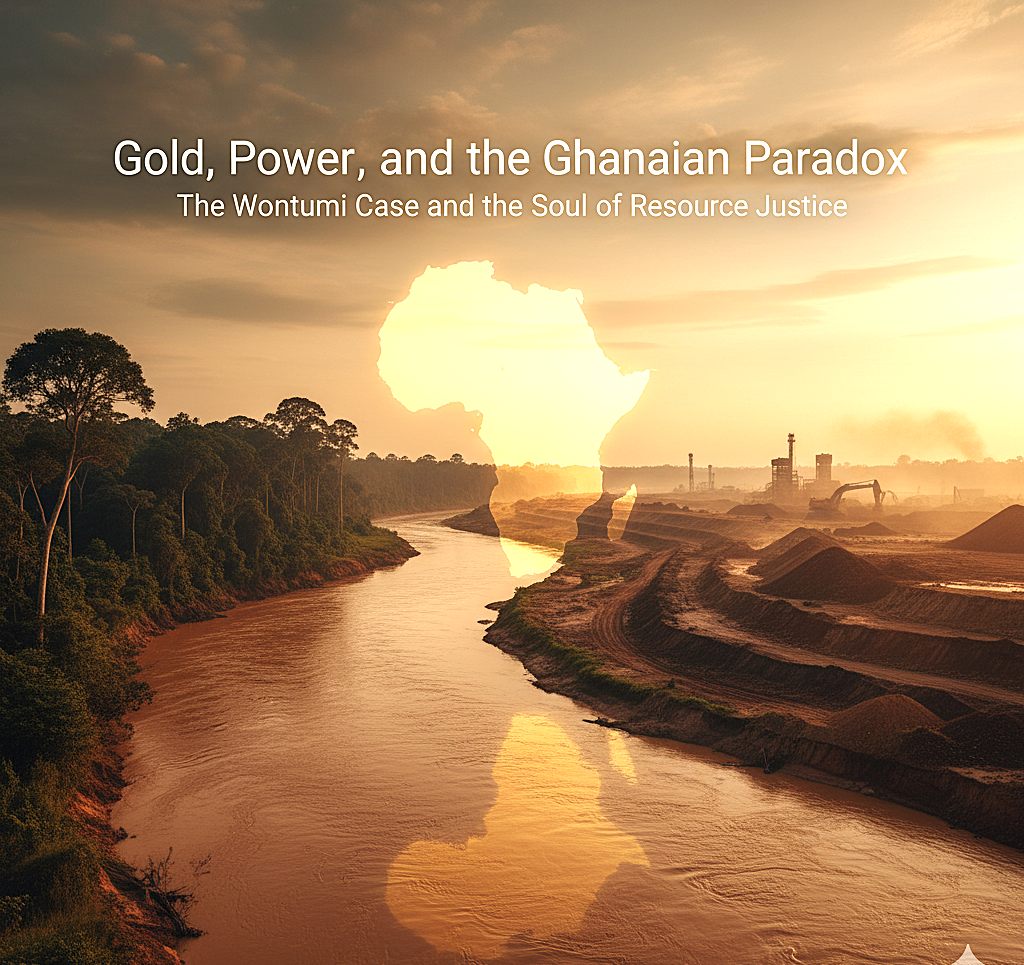
The river runs brown. It is a thick, sluggish ochre, the color of a wound that will not heal. In Samreboi, and in a hundred other communities across Ghana’s green heart, the water has been poisoned for gold. The air, once filled with the chorus of the forest, is now a constant, grinding roar—the sound of excavators chewing the earth to the bone. This is the sensory reality of a nation consuming itself. But beneath the noise lies a deeper, more profound silence: the silence of policy failure, of moral compromise, of a social contract torn asunder.
This is the Ghanaian Paradox: to be seated on a throne of gold, yet to be shackled by its weight. The case of Bernard Antwi Bosiako, known as Chairman Wontumi, is not merely a legal drama or a political scandal. It is a synecdoche for this national condition. His journey from regional party chairman to the owner of a sprawling mining empire, now facing charges of illegal purchase of mineral concessions, is a thread that, when pulled, unravels the very fabric of our relationship with resource, power, and justice. To understand Wontumi is to understand the logic of a system where the pursuit of individual wealth systematically eclipses the promise of collective prosperity.
This is more than a story of environmental crime. It is the story of a colonial ghost, still whispering in the machinery of modern governance.
II. The Wontumi Timeline: A Blueprint of Systemic Failure
The allegations against Chairman Wontumi, as detailed in court documents Case No. AC/007/2024, Republic v. Bernard Antwi Bosiako & Others, are strikingly simple in their illegality, yet complex in their implication. He is accused of using his political influence to illegally acquire and trade mining concessions, a direct violation of Ghana’s Minerals and Mining Act, 2006 (Act 703). The law is clear: concessions are not political chattel.
Yet, the timeline reveals a different story. It shows a rapid consolidation of mining assets coinciding with a meteoric rise in political power. Community testimonies from towns like Jacobu in the Ashanti Region speak not of a benefactor, but of a force. They describe farmlands swallowed by expanding pits, water sources contaminated with cyanide and mercury, and a pervasive fear of speaking out against a figure so intimately woven into the political and security apparatus.
“When the excavators came, they came with the party’s logo,” one elder, who requested anonymity for fear of reprisal, shared. “How do you fight the very power that is supposed to protect you? We are not against mining. We are against disappearance. The disappearance of our land, our water, and our right to a future.”
This is not an anomaly. It is a pattern. The Wontumi case is simply the most visible manifestation of a system where political capital and mineral capital are fungible currencies. The legal framework exists, but its enforcement is neutered by the very conflicts of interest it is meant to prevent.
III. Historical Vignettes: The Unbroken Chain of Extraction
To believe this is a new phenomenon is to misunderstand history. The ghost of Wontumi has ancestors.
In the late 19th century, the Ashanti Goldfields Corporation was founded, a colonial enterprise that extracted unimaginable wealth from the Obuasi mines while confining African workers to a segregated, subservient township. The logic was pure extraction: the value was to be shipped to London, leaving behind holes in the ground and a stratified society. The land was a resource, not a home; the people, labour, not citizens.
Then came the brief, fiery dawn of Kwame Nkrumah’s mineral nationalism. With the state’s acquisition of a 55% stake in Ashanti Goldfields, Nkrumah sought to bend the arc of extraction towards national development. The mineral wealth, he argued, must be harnessed to build schools, hospitals, and industries—to build a nation. It was a radical attempt to decolonize the purpose of the resource.
This vision was strangled by the era of Structural Adjustment. The World Bank and IMF, wielding the weapon of debt, forced a rollback of state control. Ghana was instructed to liberalize its mining sector, offering sweetheart terms to foreign multinationals to attract investment. The state retreated from its role as the primary custodian and beneficiary of its own wealth. The door was flung open, and a new class of comprador—the local intermediary who facilitates extraction for a slice of the profit—was born. Wontumi is not a break from this system; he is its logical, perfected product.
IV. Theoretical Frameworks: Galamsey as Colonial Logic Reborn
We often frame galamsey—illegal small-scale mining—as a problem of criminality or poverty. This is a profound misdiagnosis. When viewed through the lenses of political economy and philosophy, galamsey reveals itself as the direct continuation of the colonial logic.
1. Dependency Theory in the 21st Century:
Dependency theory, articulated by thinkers like Walter Rodney in “How Europe Underdeveloped Africa,” argued that the global economic system was designed to keep the “periphery” (Africa) in a state of subservient extraction to the “core” (the West). Today, the core has diversified. It is not only the Swiss refineries that buy the gold, but also the Chinese excavator manufacturers and the global financial system that launders the profits. The structure remains: Ghana is locked in the role of the raw material producer, its development stunted by the very activity that should fuel it. The environmental devastation is not an externality; it is a cost systematically offloaded onto the poor.
2. African Humanism and the Betrayal of Ubuntu:
The philosophy of Ubuntu—“I am because we are”—stands as a foundational African moral principle. It posits that our humanity is interdependent. The mining baron who destroys a community’s water source, or the politician who enables him, commits a fundamental violation of this principle. They enact a brutal, hyper-individualism that is alien to the communal ethos they often rhetorically invoke. They operate on a logic of “I am in spite of you,” a direct philosophical import from the colonial playbook that prioritized the enrichment of the crown over the well-being of the colony.
3. The Call for a Neo-Liberationism:
If Nkrumah’s era was one of political liberation, what we need now is a Neo-Liberationism—an economic and ecological liberation. This framework argues that true sovereignty in the 21st century is not just about the flag you fly, but about the control you exert over your resources, your data, and your environmental destiny. It demands a move beyond the state-versus-market dichotomy. It calls for a new social pact where mining is governed by the principle of local empowerment, measured not in royalty percentages, but in the health of ecosystems, the quality of education, and the birth of locally-owned secondary industries that add value to the raw ore.
V. Manifesto: A Call for Reclamation
The brown rivers of Samreboi are a verdict on our collective soul. The Wontumi case is a symptom of a sickness we have tolerated for too long. We have confused the presence of foreign investment with development, and the accumulation of private wealth with progress.
The mission of PowerAfrika—and the imperative for a continent at a crossroads—must be to decolonize not just our mines, but our minds.
We must decolonize our governance, by building institutions with the integrity and muscle to enforce the law without fear or favour, breaking the incestuous relationship between political office and mineral wealth.
We must decolonize our economics, by moving beyond the invoice of raw materials. Every ounce of gold, every carat of diamond, must be a seed for a local refinery, a jewelry workshop, a technology hub. We must capture the entire value chain, or we remain hewers of wood and drawers of water in the digital age.
We must decolonize our moral consciousness, by returning to the wisdom of Ubuntu. The land is not a commodity to be spent; it is a legacy to be nurtured. The wealth beneath our soil is meaningless if the soil itself is dead, and the people upon it are disempowered.
The multipolar world offers a chance to escape the old traps, but only if we have the courage to define our own terms. We can choose new masters in the East, or we can choose to be our own masters. We can continue to let our gold be a curse, or we can, finally, learn to make it a blessing.
The power to choose that future is the only power that truly matters. It is the Power of Afrika.