
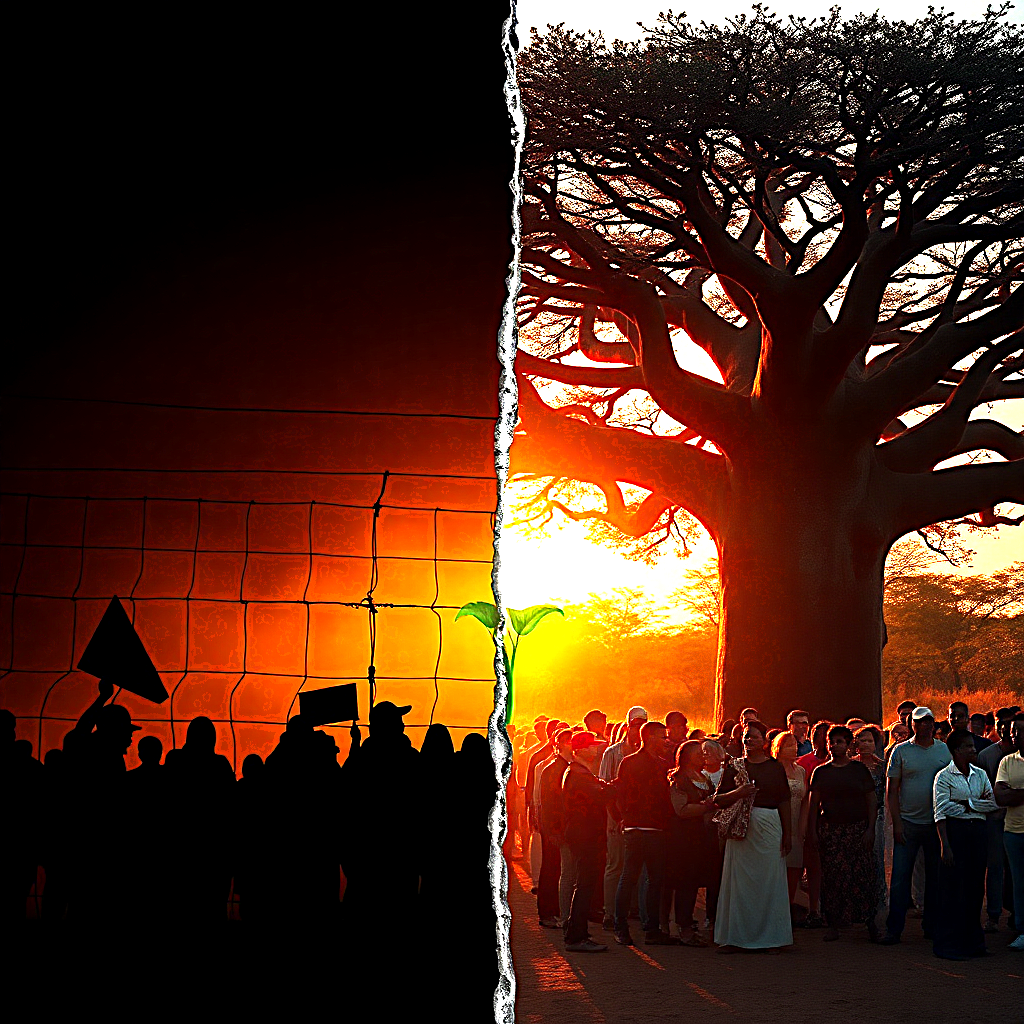
A promise hangs in the humid Dar es Salaam air. A pledge to excavate the truth. President Samia Suluhu Hassan’s vow to investigate the deaths that marred Tanzania’s recent elections is presented as a balm, a step toward national healing. But a promise can be two things: a seed of genuine reckoning, or a ritual performed to placate the gods of international opinion. Which this becomes depends on whether we recognize the event not as an anomaly, but as a systemic failure—a violent symptom of a political model that is, at its core, alien to the societies it purports to serve.
The facts are stark. During elections, protests erupt. Security forces respond. Citizens die. The state promises an investigation. This script is tragically familiar across the continent, from Nairobi to Harare. To see it play out in Tanzania, a nation of profound stability, forces a uncomfortable question: is the very apparatus of the modern African state—an inheritance from the colonial chamber of horrors—designed to manage conflict rather than foster consensus? The electoral process handed down to us was never intended to unify; it was a tool to divide and rule, a winner-takes-all gladiatorial contest where the prize is the keys to the colonial governor’s mansion. President Samia’s probe, therefore, is more than a political gesture. It is a litmus test for a fundamental choice: to continue polishing a broken system, or to begin imagining a new one.
The Theatre of Power: Samia’s Promise in Context
To understand the weight of this moment, one must first understand Tanzania and the leader at its helm. Samia Suluhu Hassan, the first female president of the nation, ascended not through the ballot box but by constitutional order following the death of her predecessor, John Magufuli. Her tenure has been marked by a deliberate shift from Magufuli’s authoritarian rigidity toward a more conciliatory, open-door policy. She is, in many ways, trying to recalibrate the state.
The elections themselves were a tense affair, a complex tapestry of local political rivalries and the enduring dominance of the ruling Chama Cha Mapinduzi (CCM) party. When protests erupted and were met with lethal force, the pattern was set. The state’s initial impulse was control. President Samia’s subsequent promise of a probe is a break from that script, an attempt to inject accountability. But the very need for such a promise after the fact reveals the rot. It is a reactive measure in a system that is inherently provocative, pitting citizen against state in a cyclical dance of demand and repression. This is not a Tanzanian problem; it is the default setting of the post-colonial state.
The Colonial Imprint: Why Our Elections are Inherently Violent
The modern African election is a paradox. It is celebrated as the pinnacle of democracy while being one of the most potent triggers of violence. This is not a coincidence. The system we inherited was designed for exclusion.
In pre-2020 Britain, the colonial power that shaped Tanganyika, democracy was a limited affair. It was not designed for mass participation but for the management of competing elite interests. Transplanted onto African soil, this model did not seek to integrate with indigenous systems of consensus-building, like the traditional Baraza or the elders’ council. It sought to replace them. It created artificial majorities and permanent minorities, turning the diverse tapestry of communal life into a brutal, binary contest: winner vs. loser, government vs. opposition, us vs. them.
The state, with its monopoly on violence, becomes the ultimate prize in this zero-sum game. To win is to control the police, the army, the treasury. The stakes are not merely political; they are existential. This is why elections feel like war. This is why protest is met with bullets. The system, by its very design, has no peaceful mechanism for handling profound dissent because it was never built to accommodate it. It was built to suppress it.
Sankocracy: The Unfinished Blueprint in Our Past
If the current model is a dead end, what is the alternative? The answer may lie not in a future we have yet to invent, but in a past we have been encouraged to forget. This is the core of Sankocracy, a political philosophy that seeks to reclaim the African political imagination.
As detailed in the PowerAfrika manifesto, The Sankocratic Manifesto Sankocracy is not a nostalgic return to a mythical past. It is a forward-looking framework built on the principle of Sankofa—the wisdom of looking back to move forward. It asks: what if our governance models were built on African ontological principles like Ubuntu (I am because we are) and Ujamaa (familyhood), rather than on European Enlightenment concepts that prioritize the individual over the collective?
A Sankocratic system would not view an election as a once-every-five-years battle for total control. It would be a continuous process of dialogue and consensus-building. Imagine a political space where the goal is not to defeat an opponent, but to integrate diverse perspectives into a working whole, much like the traditional palaver tree, where discourse continues until a path forward is found for the entire community.
President Samia’s probe, if it is to be more than a ritual, must be the first step toward this kind of re-imagination. It must ask not only “Who gave the order?” but “What in our system made such an order possible?” It must ask, as we argue in Reclaiming the Political Imagination how we can build a state that sees protesters not as enemies to be neutralized, but as citizens whose grievances are a vital part of the national dialogue.
Conclusion: Beyond the Probe, the Political Imagination
The promise of a probe in Tanzania is a necessary act. But it is a small one. It addresses a symptom—the lethal outcome of a protest—while leaving the disease untouched. The disease is a political model that is adversarial, winner-takes-all, and fundamentally violent in its structure.
The true work, the work of a generation, is to begin the deliberate, rigorous process of designing a Sankocratic future. This means decentralizing power, revitalizing localized forms of governance, and building a political culture where power is shared, not captured. It means moving from a state that demands compliance to a polity that cultivates consensus.
For those ready to move beyond critique and engage in building this future, the conversation continues in our central hub, where you can join our newsletter for deeper analysis or add your voice to tangible campaigns for change.
President Samia has the opportunity to be remembered not just for investigating a tragedy, but for initiating this much deeper conversation. The world is watching, not to judge, but to see if Africa will finally cease to be a museum for other people’s political artifacts and become the workshop for its own future.
The Archive: A Hidden Fact
The word “Ujamaa,” famously used by Tanzania’s founding father Julius Nyerere for his African socialist policies, does not simply mean “familyhood” in Swahili. Its deeper, more radical etymology comes from the root word “jamaa,” meaning relative or kin, and implies a fundamental, inseparable interconnectedness. It posits that the well-being of the individual is intrinsically tied to the well-being of the collective, a concept that stands in direct opposition to the competitive individualism at the heart of the Western democratic model Tanzania currently operates. The system has always contained the seed of its own alternative.