
I. The Unseen Earthquake
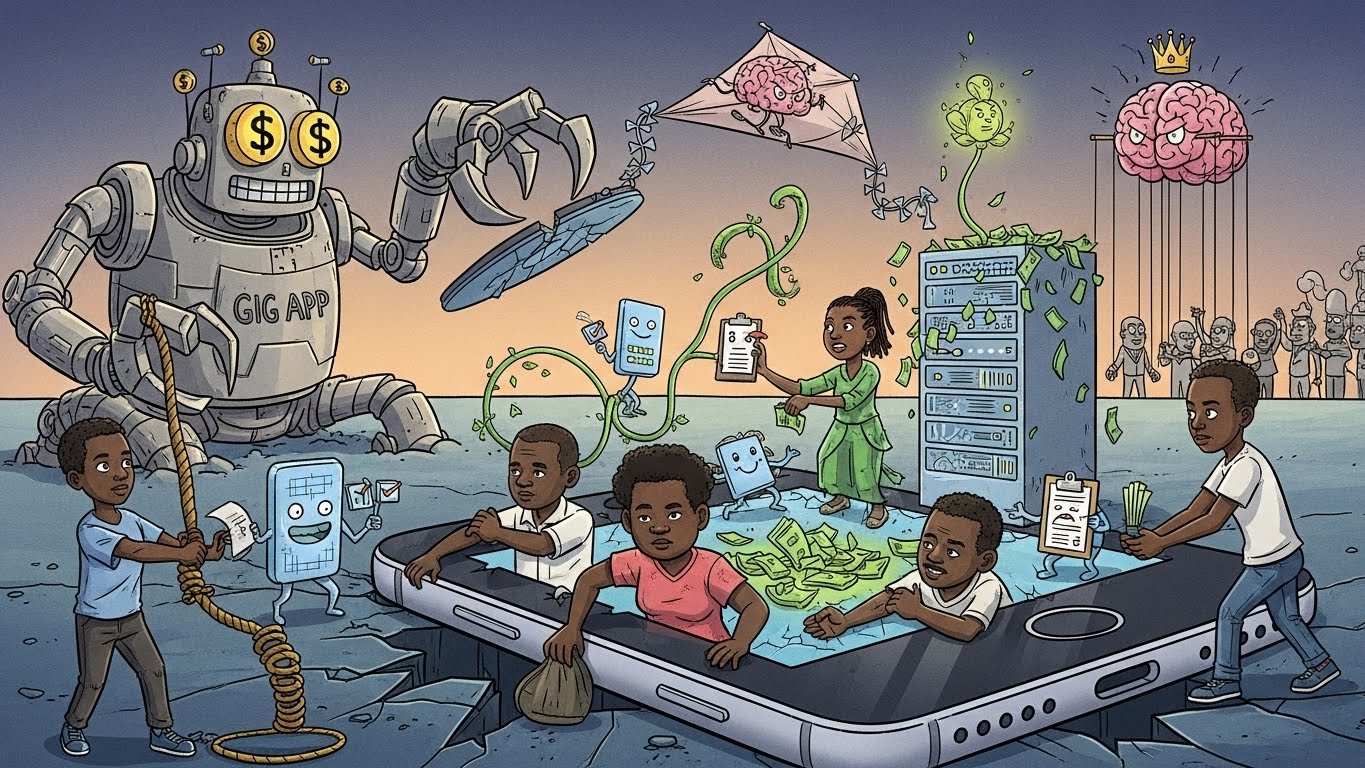
Lagos, 2035. A young man sits for the 47th day in a row at a buzzing “hive”—a warehouse filled with thousands of others, each staring at a screen, performing micro-tasks for an algorithm that pays in digital cents. His father drove a danfo bus in traffic that was human chaos. His son cannot drive at all—the vehicles are autonomous. This young man is not unemployed. He is “task-employed”—trapped in algorithmically-managed labor that provides subsistence but strips purpose, progression, and dignity. He is not “useless.” He is being made permanently precarious.
This is the logical endpoint of trends already visible. While global AI debates focus on white-collar disruption, Africa faces a more immediate threat: the systemic disenfranchisement of its youth bulge through technological marginalization. We are sleepwalking toward a social cataclysm. The “Scramble for Africa” is over. The “Algorithmic Sorting” has begun.
II. The Flawed Analogy & The Resilient Informal Reality
The common rebuttal is historical: “The Industrial Revolution also destroyed jobs, but created more.” This is dangerously misleading. The Luddites smashed looms replacing specific tasks. Today’s AI replaces entire categories of human capability.
But there is a second, equally dangerous error: assuming African economies will passively absorb this shock like Western ones. They will not. Our informal sector—constituting over 80% of employment—is a shock absorber of genius. It subverts, adapts, and survives.
- Counterpoint: The mobile money revolution (M-Pesa) was not imposed from above; it was adopted and adapted from below, creating new livelihoods (agents, float managers). AI tools will be similarly hacked—for local language content creation, micro-logistics, and informal fintech.
- The Revised Challenge: The threat is not a sudden, mass jobless event. It is a slow creep of devaluation, where formal, taxable, dignity-providing work evaporates, pushing more people into a digitally-mediated but even more exploitative informal “task economy.” The goalposts of dignified survival keep moving.
III. The Three-Tiered Future (The Hybrid Hellscape)
The binary of “Digital Plantation vs. Digital Commonwealth” is clean but false. The probable future is a three-tiered hybrid reality:
- The Digital Aristocracy (5-15%): The tech-savvy creators, green engineers, and AI overseers. They will thrive in the new economy, often as global freelancers.
- The Algorithmically Managed (30-40%): The “hive” dwellers. Formally engaged in micro-tasks, platform gigs, and data-labeling. Their income is unstable, their labor is monitored, their path upward is blocked by skills gaps.
- The Permanently Informal (45-65%): Those left behind by both the old and new economies. They hustle in the physical world, their margins squeezed by AI-powered logistics and pricing. They are the drivers, market traders, and repairers competing with machines.
This is the real quicksand: a stabilized hierarchy of inequity, where movement between tiers becomes nearly impossible. The social contract shatters.
IV. The Afrometric Response: Beyond Panic, Toward Purpose
Our strategy must be as profound and adaptive as the threat, rooted in Ubuntu—not as a romantic slogan, but as a design principle for a post-work society. We propose a Triple-Pillar Strategy, grounded in feasibility.
Pillar 1: Cognitive Sovereignty & The “Right to Be Trained”
We must legislate the right to continuous, state-subsidized reskilling, funded by a 1-2% Automation Impact Levy on companies deploying AI/robotics above a certain scale. This isn’t a tax on innovation, but a social license to operate. The curriculum must be co-created with industry and focus on AI-augmented skills: a mechanic trained to diagnose with AI, a nurse using diagnostic support tools.
Pillar 2: Build the Sovereign Stack for the Creator & Steward Economy
We cannot build a dignified future on Silicon Valley’s platforms. We need our own digital public infrastructure:
- Pan-African Creator Platform: A cooperative-owned platform for music, film, and art with fair royalties, built on open-source protocols.
- Green Stewardship Corps: A continental program certifying and deploying millions of youth as solar technicians, water system managers, and biodiversity monitors, funded by carbon credits and climate finance. This turns our ecological liability into employment leverage.
Pillar 3: Redefine Work & Introduce a Basic Dignity Package
We must decouple survival from the formal job. Pilot Basic Dignity Packages—not just cash, but bundles of guaranteed access to data, primary healthcare, vocational credits, and public transport. This reduces the terror of precarious work. Simultaneously, we must credentialize non-formal work. The community organizing, the care for elders, the upkeep of public spaces—this is work. National service programs should formally recognize and credential these contributions.
V. The First Battle: Winning the “Data Dignity” Fight
The grand strategy needs a first, winnable battle. We propose mobilizing around “Data Dignity” Legislation.
- The Law: Any platform using African user data to train AI models must (a) pay a data dividend into a continental skills fund, and (b) provide a public API for that model to African universities and startups.
- The Opponents: Big Tech lobbyists and compromised local elites who benefit from sweetheart deals.
- The Leverage: Our combined market of 1.3 billion people. We must weaponize our collective bargaining power.
This is a tangible fight. It frames the issue not as resisting technology, but as demanding a fair share of its spoils to fund our own adaptation.
VI. The Fork in the Path: Managed Decline or Negotiated Ascent
We stand at a fork, but the paths are not pure dystopia or utopia.
- Path A: Managed Decline. The three-tiered society solidifies. The Aristocracy lives in enclaves, the Managed are pacified with entertainment and micro-loans, the Informal are policed. Social order is maintained by surveillance and sporadic patronage.
- Path B: Negotiated Ascent. We use policy, taxation, and collective action to force a continuous negotiation between capital, technology, and society. We accept disruption but mandate inclusion. We use AI to reduce drudgery, not to create a new drudgery. We build an economy where the value of human connection, cultural genius, and environmental stewardship is priced into the system.
The quicksand is real. But our history is one of navigating impossible terrain. We must move now—not with panic, but with the deliberate, collective purpose our ancestors used to cross deserts. The goal is not to save every old job. It is to build a new societal compact where being human is the primary credential.
The Archive: A Hidden Fact
In the 1960s, as computers first entered the workplace, a radical idea emerged from the Scandinavian labor movement: “The Right to Be Stupid.” It argued that workers must have the protected freedom to experiment, make mistakes, and learn new systems on the job, without fear of penalty or replacement. This principle birthed some of the world’s most successful worker-retraining programs. In our age of “smart” machines, Africa must legislate the “Right to Learn, Adapt, and Humanize”—the protected space where our irreplaceable human qualities of intuition, empathy, and contextual brilliance are not weaknesses to be automated, but the core assets we cultivate.