An Essay by PowerAfrika
February 2026
I. THE CHAIR THAT HAS BEEN EMPTY FOR SIXTY YEARS
There is a chair in Ghana that has been vacant since February 24, 1966.
Not a physical chair—though we could point to Flagstaff House, now Jubilee House, and mark the exact seat where vision once sat.
Not a ceremonial chair—though Nkrumah’s actual chair sits in a museum somewhere, gathering dust behind glass, reduced to artifact.
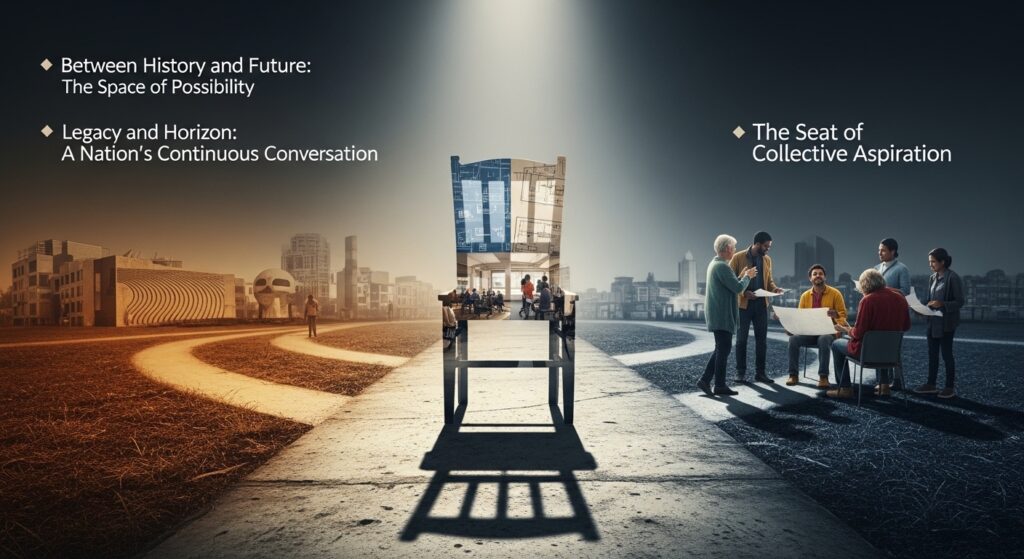
We speak of the metaphysical chair. The seat of national imagination. The place from which a leader looks not at the next election, but at the next century. The position from which someone dares to ask: “What can Ghana become?”
That chair has been empty for sixty years.
We have had occupants of State House. We have had presidents, prime ministers, military rulers, civilian administrators. We have had managers, calculators, ethnic politicians, IMF negotiators, and technocrats reading from Washington Consensus scripts.
But we have not had a visionary.
We have not had someone who sits in power and thinks: “How do I build a Ghana that will still be rising one hundred years from now?”
That chair—the chair of vision—emptied on February 24, 1966. And it has never been filled.
II. WHAT SITS IN AN EMPTY CHAIR
You might ask: “But Ghana has had leaders since 1966. What do you mean the chair is empty?”
Let us be precise.
An empty chair is not the same as an unoccupied chair.
An unoccupied chair waits for someone to sit. An empty chair has been occupied by people who brought nothing to it.
The chair of vision has been occupied by:
The Coup Plotters (1966-1969)
Who sat in Nkrumah’s chair and immediately:
- Devalued the currency (destroying savings overnight)
- Opened Ghana to IMF “stabilization” (beginning sixty years of debt dependency)
- Dismantled state enterprises (ending industrial ambition)
- Declared the visionary they overthrew a “tyrant” (rewriting history to justify theft)
They sat in the chair. But they brought no vision—only reaction. The chair remained empty.
The Managers (1969-1972, 1979-1981, 1992-2001, 2001-2009, 2009-2017, 2017-2025)
Busia. Limann. Rawlings (civilian). Kufuor. Mills/Mahama. Akufo-Addo. Different parties. Same pattern.
They managed. They administered. They negotiated with the IMF. They spoke of “growth” and “development” while exporting raw cocoa and importing chocolate for sixty-nine years.
Some were honest. Some were corrupt. Some meant well. Some did not.
But none asked Nkrumah’s question: “How do we industrialize Ghana without Western permission? How do we unite Africa into an economic bloc? How do we make Ghana an exporter of finished goods, not raw materials and educated youth?”
They sat in the chair. But they filled it with incrementalism, not imagination. The chair remained empty.
The Ethnic Calculators (All of Them)
Every government since 1966 has played the same game:
Appoint ministers by ethnic arithmetic. Award contracts by regional loyalty. Develop the areas that vote “correctly.” Neglect the regions that don’t.
Akan vs. Ewe vs. Ga vs. Dagomba. NPP vs. NDC. North vs. South. Christian vs. Muslim.
Tribal mathematics masquerading as national governance.
Nkrumah was flawed. Nkrumah was authoritarian. Nkrumah made economic mistakes.
But he never saw Ghana as ethnic fragments to be balanced. He saw it as a nation to be built and a continent to be unified.
Every leader since has governed Ghana as ethnic coalition, not national project.
They sat in the chair. But they brought division, not vision. The chair remained empty.
III. HOW WE KNOW THE CHAIR IS EMPTY
Some will resist this claim. “Ghana has developed since 1966!” they will say. “We have democracy! Infrastructure! Growth!”
Let us measure the emptiness precisely.
Test 1: The Industrial Question
If the chair of vision were occupied, Ghana would have asked sixty-nine years ago:
“We export cocoa beans. Why do we not make chocolate?”
“We mine gold. Why do we not make jewelry?”
“We harvest timber. Why do we not make furniture?”
These are not complicated questions. They are first-grade economics.
Answer: Because answering them requires vision—and vision requires challenging the global economic order that profits from Ghana remaining a raw material supplier.
The chair of vision would have said: “Build the factories. Train the engineers. Accept the conflict with foreign interests. Do it anyway.”
The empty chair said: “Accept the IMF loan. Liberalize the economy. Trust the market. Stay in your assigned position.”
Result after sixty-nine years:
- Manufacturing: 11.4% of GDP (unchanged from 1960)
- Primary exports: Still cocoa, gold, timber (raw)
- Primary imports: Still chocolate, jewelry, furniture (finished)
The chair is empty.
Test 2: The Brain Drain Question
If the chair of vision were occupied, Ghana would have asked:
“Why do our best graduates leave?”
And having asked, would have answered:
“Because we build nothing here. We create no factories for engineers to engineer. No laboratories for scientists to research. No firms for entrepreneurs to scale.”
And having answered, would have acted:
“Then we will build. We will create Special Economic Zones with reliable power. We will fund research universities. We will subsidize start-up manufacturing. We will make staying more attractive than leaving.”
The empty chair never asked. Or asked and never acted.
Result:
- 2.5 million skilled Ghanaians live abroad
- Every year, our best graduates board planes at Kotoka International Airport (named for the coup plotter, naturally)
- Every year, we pay billions to train doctors who heal British patients, engineers who build Canadian infrastructure, programmers who code for American companies
The brain drain is not migration. It is tribute—paid by the poor nation to the rich, because the poor nation’s chair of vision is empty.
Test 3: The Pan-African Question
If the chair of vision were occupied, Ghana would have asked:
“Nkrumah said Ghana’s independence is meaningless without African unity. Was he right?”
Sixty-nine years of fragmentation answer: Yes.
- Small, divided African states have no bargaining power in global markets
- We compete against each other (cocoa producers undercutting each other’s prices)
- We cannot build continental infrastructure (rail, power grids, telecommunications)
- We accept terrible terms of trade because we negotiate as 54 fragments, not one bloc
The African Continental Free Trade Area—Nkrumah’s vision—finally launched in 2021.
Fifty-eight years late.
And Ghana, which should have led, mostly watched from the sidelines—because the chair of vision has been empty for sixty years.
Test 4: The Airport Question
This is the test that reveals the emptiness most starkly.
A nation with vision occupying the chair would say:
“Our founder built modern Ghana. His flaws do not erase his achievements. We will name our international gateway after him—and teach the full, complicated story.”
Ghana in 2026 says:
“We will remove the coup plotter’s name—good. But we cannot agree on Nkrumah because tribal politics prevents consensus. So we will call it ‘Accra International Airport’—which means nothing, honors no one, and teaches our children that Ghana has no story worth telling.”
A nation that cannot name its own gateway after its own founder is a nation whose chair of vision is empty.
And we wonder why our youth emigrate.
IV. THE EMPTY CHAIRS EVERYWHERE
Once you see the empty chair at the center of national power, you begin to see empty chairs everywhere.
Walk through the University of Ghana:
Where is the chair of the professor who teaches: “How Ghana Can Industrialize Without IMF Permission”?
Empty.
The economics department teaches neoliberal orthodoxy. The business school teaches how to work for foreign firms. The engineering school trains students who will build infrastructure in Canada, not Ghana.
The chair of sovereign development thinking is empty.
Walk through Parliament:
Where is the chair of the legislator who stands every session and asks: “Why are we still exporting raw cocoa after sixty-nine years of independence?”
Empty.
MPs ask about roads in their districts (ethnic development). Contracts for their regions (tribal spoils). Positions for their allies (patronage).
The chair of national vision is empty.
Walk through the Ministry of Trade:
Where is the chair of the bureaucrat designing Ghana’s fifty-year industrial strategy?
Empty.
The ministry negotiates trade agreements. Facilitates exports (of raw materials). Promotes investment (mostly foreign extraction).
The chair of long-term planning is empty.
Walk through Ghana’s boardrooms:
Where is the chair of the CEO who says: “I will build a Ghanaian chocolate company that competes with Cadbury globally”?
Empty.
Ghana’s business elite imports. Trades. Arbitrages. Represents foreign brands. Extracts rents.
The chair of industrial entrepreneurship is empty.
Walk through our media:
Where is the chair of the journalist who investigates: “Which foreign powers benefit from Ghana remaining a raw material exporter—and how do they maintain this system?”
Empty.
Our media covers politics (which party is winning tribal arithmetic). Scandals (which politician is corrupt). Sports.
The chair of structural investigation is empty.
Walk through our homes:
Where is the chair of the parent who tells their child: “You will stay in Ghana, build in Ghana, die in Ghana—because this is your nation and you will make it great”?
Empty.
We tell our children: “Study hard. Get good grades. Go abroad. Send money back.”
The chair of national commitment is empty.
V. FEBRUARY 24, 1966: THE DAY THE CHAIR EMPTIED
Some will say: “You romanticize Nkrumah. Ghana was not perfect under him.”
True. And irrelevant.
We do not claim Nkrumah was perfect. We claim the chair of vision was occupied under him—and has been empty ever since.
Under Nkrumah, someone sat in power and asked:
“How do we generate our own electricity?” → Built Akosombo Dam (still powers 30% of Ghana’s grid)
“How do we educate our own professionals?” → Built three universities in nine years
“How do we trade without British control?” → Built Tema Harbour (handles 70% of Ghana’s trade today)
“How do we unite Africa?” → Founded OAU (now African Union)
Did he govern autocratically? Yes.
Did he make economic errors? Yes.
Did he create a personality cult? Yes.
And yet: He filled the chair of vision.
He asked questions about Ghana’s future in 2057, not 1961.
He built infrastructure that we still use sixty-nine years later.
He imagined a Ghana that did not yet exist—and worked to create it.
On February 24, 1966, that stopped.
The coup plotters removed the visionary and installed managers.
And Ghana has been managed ever since.
Managed decline. Managed dependency. Managed extraction.
But never again visioned.
VI. THE COST OF THE EMPTY CHAIR
What has the empty chair cost Ghana?
Materially:
- ₵800 billion in lost industrialization (conservative estimate)
- 2.5 million skilled citizens emigrated
- Sixty years of debt dependency
- A generation raised to see leaving as success
Psychologically:
- National learned helplessness (“We can’t build; we can only manage”)
- Chronic low expectations (“Ghana will always be like this”)
- Vision became suspect (“Anyone who promises too much is lying or dangerous”)
- Youth who cannot imagine Ghana as anything other than what it is
Spiritually:
- A people who cannot name their founder
- A nation that honors its destroyer longer than its builder
- A collective amnesia about what was stolen
- An empty chair where imagination should sit
VII. THE RITUAL: MAKING THE EMPTINESS VISIBLE
PowerAfrika calls for a national ritual.
Not a protest. Not a demonstration.
A ritual of collective grief.
Because before Ghana can fill the empty chair, we must acknowledge that it is empty.
Before we can reclaim vision, we must mourn its absence.
Before we can name the airport after Nkrumah, we must face what we lost when Nkrumah was removed.
The ritual is simple:
Step 1: The Empty Chair in Your Space
Place an empty chair in a visible location:
- Your home
- Your office
- Your classroom
- Your church or mosque
- Your market stall
- Your street corner
Let it sit empty. Visibly, uncomfortably empty.
Step 2: The Sign
Attach a sign to the chair:
“Ghana’s Seat of Vision”
“Empty Since February 24, 1966”
“Reserved for Leaders Who Dare to Build”
Step 3: The Photograph
Photograph the empty chair.
Post it on social media with the caption:
“This is Ghana’s chair of vision. It has been empty for sixty years. We kept Kotoka’s name but lost Nkrumah’s future. #TheEmptyChair #NameItNkrumah”
Step 4: The Collective Witness
As thousands of empty chairs appear across Ghana—in homes, universities, markets, streets—the emptiness becomes undeniable.
Not metaphor. Material reality.
Ghana’s leadership vacuum, made visible.
Step 5: The Question
Once the emptiness is visible, the question becomes unavoidable:
“Who will fill this chair?”
Not with management. Not with ethnic arithmetic. Not with IMF-approved policy.
With vision.
VIII. FROM GRIEF TO ACTION: FILLING THE CHAIR
The empty chair ritual is not the end. It is the beginning.
Phase 1: Acknowledgment (We see the emptiness)
Phase 2: Mourning (We grieve what was lost)
Phase 3: Anger (We rage at those who emptied it)
Phase 4: Demand (We insist it be filled)
Phase 5: Action (We fill it ourselves)
The airport naming is Phase 4.
By refusing to name the airport “Nkrumah International,” Ghana refuses to fill the chair.
By choosing “Accra International,” Ghana declares: “We are too divided, too afraid, too small to claim our founder—so we will claim geography instead.”
This is the empty chair speaking: “Nothing. No one. Neutrality. Safety.”
Naming it “Kwame Nkrumah International Airport” would be the first step toward filling the chair:
It would force Ghana to ask:
- Who was he?
- What did he build?
- What did he destroy?
- Why was he overthrown?
- What did we lose?
- Can we reclaim it?
These questions lead to vision.
And vision fills empty chairs.
IX. THE EMPTY CHAIR AT KOTOKA INTERNATIONAL AIRPORT
PowerAfrika will place an empty chair at Kotoka International Airport.
Location: Arrivals hall, where every visitor to Ghana first steps onto Ghanaian soil.
Sign on the chair:
“Welcome to Ghana”
“Where the chair of vision has been empty since 1966”
“Where we honor the coup plotter but fear to name the founder”
“Where we export our youth because we build nothing for them to build”
“This chair waits for leaders brave enough to fill it”
“Name the airport Nkrumah. Fill the chair.”
We invite:
- Airport authorities to allow it (unlikely, but we ask)
- Ghanaians to visit and photograph it
- Travelers to sit in it (briefly, symbolically)
- The government to explain why it remains empty
We understand:
The chair will likely be removed by security.
Good.
Let them remove it. Let them explain to the cameras why Ghana cannot tolerate an empty chair that tells the truth.
The removal will prove the point better than the chair itself.
X. CONCLUSION: THE CHAIR IS WAITING
Somewhere in Ghana tonight, a student studies engineering—planning to emigrate after graduation because Ghana builds nothing.
Somewhere tonight, a parent tells their child: “Work hard so you can leave this country.”
Somewhere tonight, a leader sits in an office calculating ethnic arithmetic instead of imagining national futures.
Somewhere tonight, the empty chair waits.
It has waited sixty years.
It will wait sixty more—unless we choose to fill it.
The first step is naming what is empty.
The second step is mourning what was lost.
The third step is raging at what was stolen.
The fourth step is demanding it be restored.
The fifth step is building what should have been built.
Ghana, your chair of vision is empty.
The clearest proof? You cannot even name your airport after the man who built modern Ghana.
Because naming it after him would require admitting:
- That he was a visionary (and we have had none since)
- That he was overthrown (by foreign powers we still fear)
- That we lost something (we never recovered)
- That the chair has been empty (for sixty years)
“Accra International Airport” is the empty chair’s name.
It means: “We have no vision. We have no founders we dare to claim. We have no story worth telling.”
“Kwame Nkrumah International Airport” is the beginning of filling the chair.
It means: “We know who built us. We teach his full story—achievements and failures. We reclaim the vision that was stolen. We fill the empty chair.”
The chair is waiting, Ghana.
Will you finally sit in it?
Or will you keep it empty for another sixty years—while calling it by a city’s name and wondering why your children keep leaving?
The choice is yours.
But the chair remains empty until you make it.
— PowerAfrika
We are the memory of the vision that was stolen.
We are the voice of the chair that waits to be filled.
We are the demand that Ghana finally become what it almost was.
#TheEmptyChair
#NameItNkrumah
#FillTheChair
#Feb241966
#60YearsEmpty