By the Office of the Chief Counsel, PowerAfrika
Editor’s Note: This piece is part of The Indictment Series — a PowerAfrika legal campaign examining the moral, constitutional, and ecological crimes committed under the guise of legality in Ghana’s natural resource governance.
I. The Legal Mask of Theft
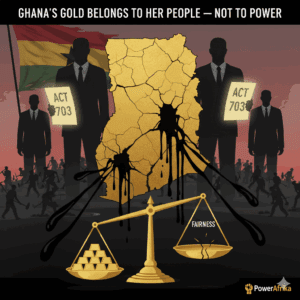
Every empire of corruption dresses itself in law. In Ghana, that mask bears the name The Minerals and Mining Act, 2006 (Act 703)—a statute designed, ostensibly, to regulate extraction for national benefit, yet written in such a way that it privatizes risk, socializes loss, and consecrates exploitation.
Act 703 was not merely a legislative oversight; it was a blueprint for elite capture.
Its language appears technical, but its effect is political: it centralizes power in the Ministry of Lands and Natural Resources while decentralizing accountability. It gives the illusion of state ownership while delivering operational control to private hands—both foreign and domestic.
What should have been the people’s inheritance became a legalized heist.
II. The Constitutional Betrayal
Article 257(6) of Ghana’s 1992 Constitution is unambiguous:
“Every mineral in its natural state in, under or upon any land in Ghana, rivers, streams, watercourses throughout Ghana… is the property of the Republic of Ghana and shall be vested in the President on behalf of, and in trust for, the people of Ghana.”
But a trust violated ceases to be a trust—it becomes embezzlement in public disguise.
When the President or his ministers issue “mining consignments” or “reconnaissance licenses” to individuals, they breach that sacred trusteeship.
The minerals do not belong to the office-holder; they belong to the sovereign—the people.
Thus, every private license issued without transparent national benefit is not merely administrative malpractice. It is a constitutional sin—a betrayal of the social contract between the governors and the governed.
III. The Architecture of Elite Capture
Let us dissect how Act 703 operationalizes plunder:
-
Discretionary Licensing Power – The Minister has near-total discretion to grant, renew, or revoke licenses, with minimal public oversight. This has turned mining rights into political currency—bought, sold, or traded within circles of influence.
-
Weak Environmental Impact Assessments (EIA) – Companies are often granted licenses before credible EIAs are conducted. In practice, “consultations” are perfunctory, reports are outsourced, and approvals are rubber-stamped.
-
Opaque Beneficial Ownership – The Act does not compel full disclosure of who actually owns the concession. Shell companies, middlemen, and political proxies dominate the landscape, ensuring that the “local content” clause serves the elite, not the community.
-
Revenue Leakage – Royalties are a paltry 3–5%, easily evaded. Auditing is infrequent. Billions vanish annually in transfer mispricing and smuggling, while mining communities sit on poisoned soil with no clean water.
-
No Mandate for Ecological Restoration – When mining firms leave, they leave craters. Act 703’s reclamation clauses are vague, unenforced, and easily bypassed through “technical exemptions.”
The result? A nation rich in minerals yet impoverished in justice.
IV. From Colonialism to Internal Empire
What we confront is not development but domesticated imperialism.
Yesterday, it was the British extracting gold under the Crown’s authority.
Today, it is Ghanaian elites and foreign corporations extracting gold under the Republic’s authority.
The actors changed; the structure did not.
What colonial masters once did with gunboats, local elites now do with government seals.
The gold has not changed color; only the beneficiaries have.
This is not independence—it is colonialism in kente cloth.
V. The Human Cost
Visit Tarkwa, Obuasi, or Prestea—not as a journalist, but as a witness.
You will see children wading through mercury-stained rivers. Farmers watching their cocoa trees die from poisoned soil. Entire communities displaced, their lands traded away by distant bureaucrats they have never met.
And yet, in Accra, one sees convoys of new luxury vehicles and real estate developments rising like monuments to moral decay.
Ghana’s poor are paying for the prosperity of a few. The people drink the poison while others sell the cure.
VI. Legal Reform as Moral Imperative
We, the Counsel of PowerAfrika, therefore indict the government of Ghana for moral dereliction and constitutional betrayal.
The following reforms are not requests—they are demands of justice:
-
Abolish Private Resource Consignments.
No individual or company should hold private ownership over what the Constitution vests in the Republic. -
Public Beneficial Ownership Registry.
Every mining license must disclose its real owners, financiers, and political affiliates. -
Ecological Accountability Tribunal.
A national tribunal to prosecute environmental crimes and compel full restoration of damaged ecosystems. -
Community Trusteeship Mechanism.
A fixed percentage of all mining revenues must be paid directly to affected communities—not filtered through bureaucracies. -
Full Publication of Licenses.
Every active mining concession, its coordinates, operator, and royalties paid must be published quarterly.
Until this is done, the law remains a lie written in the language of justice.
VII. The Verdict of History
History is not kind to governments that rob their own people.
Ghana cannot continue pretending to be poor while her soil is rich.
Gold has become a curse because the people’s will has been silenced.
But PowerAfrika declares: No more.
We will not allow the few to turn the nation’s inheritance into private treasure.
Every ounce of gold, every drop of oil, every grain of lithium belongs not to ministers or magnates, but to the children yet unborn.
To exploit what belongs to the collective for private gain is not entrepreneurship—it is treason against the soul of the Republic.
VIII. Call to Action
Demand full public disclosure of all mining licenses.
Demand the end of private resource consignments.
Demand the cleansing of Act 703.
Let the cry go forth from every classroom, newsroom, and village square:
“Ghana’s gold belongs to Ghana’s people.”
“When law becomes the language of theft, resistance becomes the duty of the people.”
— PowerAfrika Legal Desk