
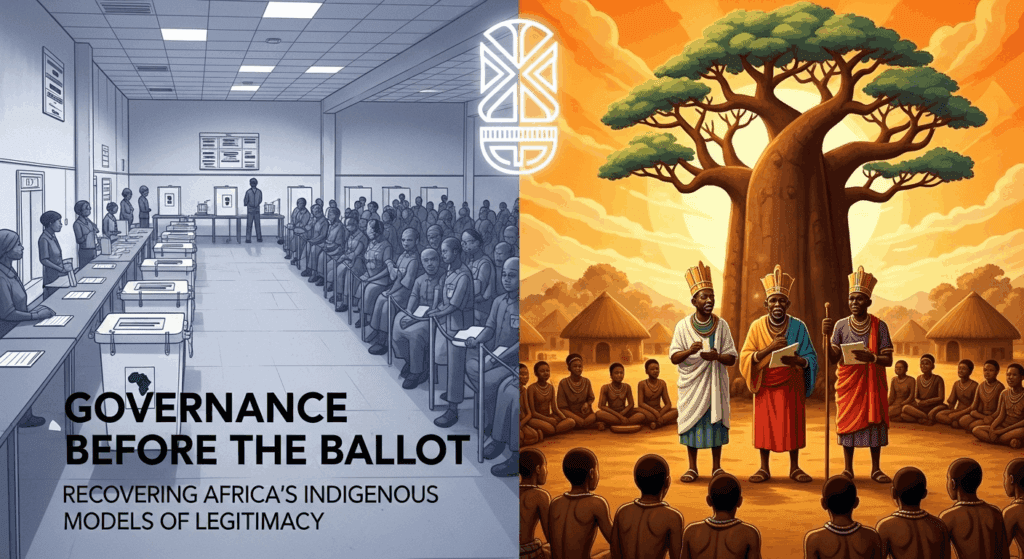
Subtitle: Remembering African Models of Legitimate Leadership Beyond Elections
Introduction:
This essay challenges the presumed universality of electoral democracy as the pinnacle of political legitimacy. It argues that precolonial African societies practiced governance through communal consensus, ancestral responsibility, and moral leadership long before the ballot was introduced. By recovering these models, Sankocracy articulates a new, African-centered path forward.
1. The Tyranny of the Ballot as the Sole Model
Elections have become sacrosanct. Legitimacy is now reduced to periodic vote-counting exercises, often marred by manipulation, foreign interference, and violence. The ballot is elevated as the gold standard, erasing thousands of years of African political ingenuity.
2. Precolonial Traditions of African Governance
From Akan stool customs to Igbo village councils, African societies developed intricate mechanisms of accountability, balance, and succession. Power was often decentralized, spiritually anchored, and communally negotiated. Leaders were judged not by charisma or popularity, but by their fidelity to ancestral mandates and communal stewardship.
3. What the Ballot Cannot Capture
Elections cannot quantify wisdom, integrity, or moral gravitas. Popularity does not guarantee justice. Wealth can buy votes, but not trust. The ballot, in its current form, measures little more than name recognition and campaign resources.
4. Why Africa Must Reimagine Authority
Imported electoral systems reproduce dependency and disillusionment. They favor those with access to capital and foreign endorsement. A truly African system must be morally resonant, culturally embedded, and spiritually grounded. It must make space for elders, councils, and communal consensus, alongside digital innovation and participatory tools.
5. Sankocracy’s Governance Vision
Sankocracy proposes a fusion: ancestral governance fused with modern tools. Legitimacy comes not solely from votes but from a layered system that includes digital citizen assemblies, village councils, spiritual endorsements, and narrative sovereignty. Leadership is not a contest, but a covenant.
Core Argument:
Before the ballot, there was governance—accountable, wise, and anchored in African cosmologies. To recover our future, we must reclaim our past, not to replicate it, but to regenerate its spirit for a new age.