
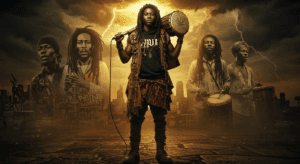
There is a sound that has haunted the corridors of empire since the first drumbeat was struck in defiance of a master’s whip. That sound has changed shape over centuries — from the spirituals echoing through the cotton fields to the thunder of Nyabinghi drums in the hills of Jamaica, from the smoky Lagos stages where Fela Kuti preached revolution in rhythm, to the streets of the Bronx where the children of diaspora carved poetry into survival. That sound is Black liberation. And it does not ask permission to speak. It roars.
Music, in the African world, has never been mere entertainment. It is communion. It is memory. It is resistance coded in harmony and beat. When enslaved Africans were stripped of their tongues, they turned to rhythm as language. When they were denied scripture, they wrote psalms with their feet and lungs and fists. Bob Marley understood this deeply when he sang, “Emancipate yourself from mental slavery, none but ourselves can free our minds.” That was not a metaphor. It was a spiritual injunction. A summons. A trumpet blast before the gates of Babylon.
The colonizer feared the drum because it spoke a language he could not decode — one that bypassed reason and moved directly through bone and soul. The same can be said of reggae’s offbeat pulse, hip-hop’s unrelenting cadence, Fela’s hypnotic saxophone — they all whisper to the ancestral self. They call forth a memory that refuses to forget. This is why liberation music is always under surveillance. Why prophets like Marley were watched. Why Fela was beaten. Why Tupac was murdered. Why revolutionary hip-hop is pushed to the algorithm’s shadows while vacuous materialism dominates the charts.
I do not write this from a place of nostalgia. I write from fire. Because the crisis is not behind us. It is now. And still, the rebel music rises.
Burning Spear never sang to be liked. He sang to awaken. In “Marcus Garvey” he thundered, “No one remember old Marcus Garvey!”—a dirge and a challenge. In those four words, he indicted a whole system of cultural amnesia. Horsemouth, in Rockers, rode through Babylon not as a passive figure but as a sonic revolutionary — his drumming not just for rhythm, but for rupture.
Reggae is not just music. It is a theology of defiance. Rastafari reclaims the sacred from the colonizer’s grasp and plants it in the soil of Black sovereignty. It rejects imposed scriptures and imperial creeds. It dares to say, “If I am guilty, I will pay,” — not with shame, but with righteous boldness. Even the lyrics “I shot the sheriff, but I didn’t shoot no deputy” are not confessions of crime — they are declarations of spiritual autonomy, a refusal to be judged by unjust laws.
And then there is Fela — the Black President. The oracle of Kalakuta. His “Zombie” mocked the blind obedience of soldiers, while “Water No Get Enemy” taught us that truth, like spirit, cannot be restrained. Fela didn’t just play music — he confronted power with it. He built a commune, defied the military, and used the stage as courtroom, pulpit, and warfront. For that, he paid dearly. But he never bowed.
Hip-Hop, too, was born of the same flame. The early prophets — Grandmaster Flash, KRS-One, Public Enemy — turned turntables into pulpits. “Fight the Power,” “The Message,” “By the Time I Get to Arizona” — these were not songs, they were manifestos. Later, artists like Dead Prez would pierce the silence with lyrics like, “I’m sick of the corporate slave ship, I’m sick of your rhetoric.” And even in modern echoes, Kendrick Lamar reminds us that “We gon’ be alright” — a psalm for the streets after tear gas and body bags.
But let us not be deceived: the system has learned how to co-opt the sound while silencing the meaning. Marley’s face now sells T-shirts in malls where no one listens to “Crazy Baldheads”. Hip-hop is flooded with empty braggadocio while the prophetic voices are drowned in noise. Capitalism devours resistance, dresses it in gold chains, and sells it back to us stripped of its soul.
Yet I believe in the sound. I believe in its pulse. I believe it still lives in the underground mixtape, the street cypher, the Rasta drum circle, the backroom Afrobeat jam. I believe it lives in voices like mine — and yours — when we refuse to compromise our memory. I believe that music remains our most enduring scripture — because even when they ban books, bomb schools, and whitewash our history, they cannot silence the drum in our chest.
The sound of Black liberation is not a relic. It is not finished. It is not safe. It is a fire that devours lies, a rhythm that reclaims names, a melody that says: “We are still here, we are still Black, and we are not for sale.”
Let them fear our sound. It means we are alive.