
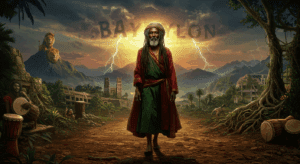
They have tried, for centuries, to tame the Black soul—scrubbing it of memory, blinding it to its origin, severing it from its god. They came with ships, flags, and bibles, not seeking converts but commodities. They taught that salvation looked like them, sounded like them, and knelt before altars built by empire. But something ancient refused to die. Somewhere in the sugarcane fields of the Caribbean, in the red clay of the highlands, in the bone memory of stolen people, a seed stirred. It did not ask permission. It did not wait for approval. It rose, raw and sovereign. And it named itself Rastafari.
Not a religion, no. That word is too small, too brittle, too corrupted. Rastafari is something else—a reckoning. It is a howl across time, a theology forged in the furnace of slavery and crowned with dreadlocks, fire, and refusal. It emerged not from universities or monasteries, but from the barefoot prophets of Kingston’s ghettos, the drumbeats of Nyabinghi, the whispers of ancestors who knew that Babylon wears many masks. At its core lies a declaration that still shakes the foundations of empire: God is Black. God is African. God has dreadlocks. This is not metaphor. This is liberation theology spoken in the language of the dispossessed.
They called him Haile Selassie. Ras Tafari Makonnen. King of Kings. Elect of God. Emperor of Ethiopia. His coronation was not simply a geopolitical event, it was a rupture in the myth of white divinity. For a people told for generations that their skin was sin and their continent cursed, here stood a Black man—robed, crowned, revered—on the throne of David. Whether seen as God incarnate, messianic monarch, or symbol of sovereignty, Haile Selassie became the gravitational center of a movement that would defy colonial logic and dare to see the divine in itself.
But even before Selassie, there was the voice of thunder—Marcus Mosiah Garvey. A man with no army, no land, no title, yet he marched at the frontlines of diasporic consciousness. His was the trumpet that sounded the alarm: “Look to Africa.” His was the vision that declared the white man’s God a lie and the Black man’s return inevitable. Rastafari took that call and made it flesh. Not as an intellectual exercise, but as a living praxis. A sacred insurgency. A turning of the gaze inward and eastward, toward the motherland and the self.
And yet, Rastafari does not beg for validation. It does not perform spirituality for academic palates or theological textbooks. It refuses the approval of Babylon’s scholars. It is not afraid to be wrong, because it is more dangerous to be obedient to a lie. Rastas have been mocked, criminalized, exoticized. They have been reduced to stereotype and spectacle. But what those mockers fail to see is the depth of the covenant being lived out. This is a people who, in full view of empire, said: We will not eat your food, we will not wear your clothes, we will not cut our hair, and we will not worship your gods. That is not eccentricity. That is revolution.
Even within Rastafari, the theology is not monolithic. Some see Selassie as divine. Others as a symbol. Some await a literal repatriation to Africa. Others seek spiritual return. There are divisions—yes, real and profound. But they are the divisions of a family debating the path home, not the silence of a conquered people. And despite these theological divergences, there is a shared heartbeat: Babylon must fall. Africa must rise. The Black man must remember that he is holy.
This remembering does not occur in isolation. It sings through the voices of the psalmists—Bob Marley, Peter Tosh, Burning Spear. These were not entertainers. They were griots armed with guitars, sages disguised as singers. When Marley sang of redemption, he was not selling records—he was conducting exorcisms. When Tosh demanded equal rights and justice, he did so with the clarity of a prophet who had stared into the eyes of Caesar and spat. Their music was scripture set to rhythm. Their albums, altars of sound. They told the youth to chant down Babylon not with bullets, but with consciousness.
Still, let us not romanticize. Let us not flatten the movement into a flawless myth. Rastafari has faced criticisms—some valid, some misguided. Questions of gender, the role of women, rigid hierarchies, and eschatological literalism are part of the discourse. And they should be. But critique must not be confused with condemnation. You do not abandon a tree because some of its branches need pruning. Rastafari may not be perfect, but it is defiant. It is alive. And more than anything, it is ours.
Rastafari matters today not because of nostalgia, but because Babylon has not died—it has evolved. It speaks now in algorithms, global finance, border patrols, false prophets, and the continued desecration of African bodies and African lands. The system remains, cloaked in the rhetoric of progress but built on the same old lie: that Africa is inferior, that Blackness is burden, that divinity is pale. Against this lie, Rastafari rises again and again, a thorn in the side of the oppressor, a balm to the soul of the oppressed.
To walk the path of Rastafari is to carry fire in your chest and grace in your hands. It is to look at a world built on forgetting and say, I will remember. It is to know that the journey to Africa is not merely across oceans, but through the rubble of colonial consciousness. And it is to say, when the world accuses you of heresy, delusion, or madness: If I am guilty, I will pay. Not with apology. Not with retreat. But with the fierce dignity of one who would rather fall on his feet than live on his knees.
Rastafari is not waiting to be understood. It is not asking for permission. It is simply walking forward, dread and barefoot, toward a truth older than pyramids and deeper than scripture. A truth that says, in every dialect and drumbeat: Africa is holy. The Black man is divine. Babylon will burn. Zion awaits.
Let the world tremble. We are coming home.