Editor’s Note:

This statement reflects PowerAfrika’s official position on the ownership and governance of Africa’s natural resources. It is not merely commentary on one case, but a broader indictment of systems that privatize what belongs to the people.
By the Office of the Chief Counsel, PowerAfrika
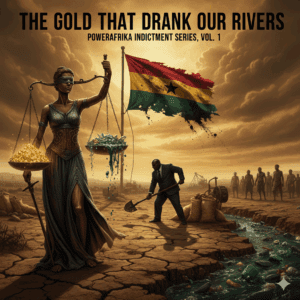
There comes a time in every nation’s story when silence becomes treason. Ghana has reached that moment. The land bleeds gold, yet her children thirst. The rivers are brown with poison, the forests stripped, the air unbreathable, and the wealth buried beneath our feet feeds only the appetites of a few.
This is not fate. It is betrayal.
The Law That Made the People Owners—And the Leaders Usurpers
Article 257(6) of Ghana’s 1992 Constitution is clear:
“Every mineral in its natural state in, under or upon any land in Ghana, rivers, streams, watercourses throughout Ghana is the property of the Republic of Ghana and shall be vested in the President on behalf of, and in trust for, the people of Ghana.”
The President is not owner. He is trustee. The government is not proprietor. It is guardian. Every ounce of gold, every barrel of oil, every grain of bauxite belongs to the people collectively, not to politicians, chiefs, or corporate elites.
Yet, through a web of opaque licensing schemes and private mining consignments, this sacred trust has been defiled. The state has converted stewardship into ownership, trusteeship into personal gain. The Minerals and Mining Act (Act 703), instead of safeguarding the people’s patrimony, has become a tool for legalized looting.
The Great Usurpation
Under the guise of “private small-scale mining,” licenses are parceled out to party loyalists, financiers, and powerful businessmen who treat them as birthrights. The result: hundreds of hectares of land are scarred, rivers are turned to mercury-laden sludge, and communities are displaced—all while the government feigns ignorance.
The argument that “local ownership” replaces foreign control is a lie. Internal exploitation is no better than external exploitation—it is colonialism wearing Kente. What difference does it make if the plunderer speaks Twi instead of English? The moral crime is the same: theft of what belongs to all.
The Constitutional Breach
Let the record show that Ghana’s leaders have violated the fundamental covenant of Article 257(6). When trustees convert the people’s property for private profit, it ceases to be governance and becomes embezzlement of sovereignty.
By issuing private mining consignments, the state has:
-
Breached its fiduciary duty to act solely in the public interest.
-
Subverted constitutional trusteeship by transferring public property to private hands.
-
Endangered public health through environmental negligence.
-
Perpetrated economic injustice by concentrating wealth among elites.
This is not merely a policy failure. It is a crime against the Constitution and against nature itself.
The Moral Dimension
In Akan cosmology, the Earth is a living being—Asaase Yaa, the Great Mother. To poison her rivers is to desecrate the womb of creation. The old Ghanaian ethos of communal stewardship—Ntiaseɛ, interdependence—has been replaced by greed and short-term gain.
We have broken not just the law, but the moral fabric that once bound community to nature. When the rivers die, the people die with them.
The Call for Reckoning
PowerAfrika demands immediate reform and accountability:
-
Abolish all private mineral consignments and exclusive licenses.
-
Revoke and audit all existing mining concessions granted under Act 703.
-
Establish a People’s Resource Trust, accountable directly to Parliament and the citizenry, not to political appointees.
-
Declare a National Environmental Emergency, focusing on river restoration and ecological rehabilitation.
-
Institute a Constitutional Tribunal to investigate breaches of Article 257(6).
The Verdict of History
The true measure of sovereignty is not in flags or anthems, but in who controls the land beneath the flag. Ghana cannot claim independence while her resources are partitioned like colonial spoils.
Let it be known: PowerAfrika stands for Resource Sovereignty—the right of African peoples to own, manage, and benefit from their natural wealth without exploitation, whether foreign or domestic.
If this broken covenant is not restored, Ghana will not only lose her rivers; she will lose her soul.
Call to Action:
Join PowerAfrika’s campaign for Resource Sovereignty and the creation of a People’s Resource Trust. Ghana’s future must be owned by Ghanaians—all of them, not the privileged few.