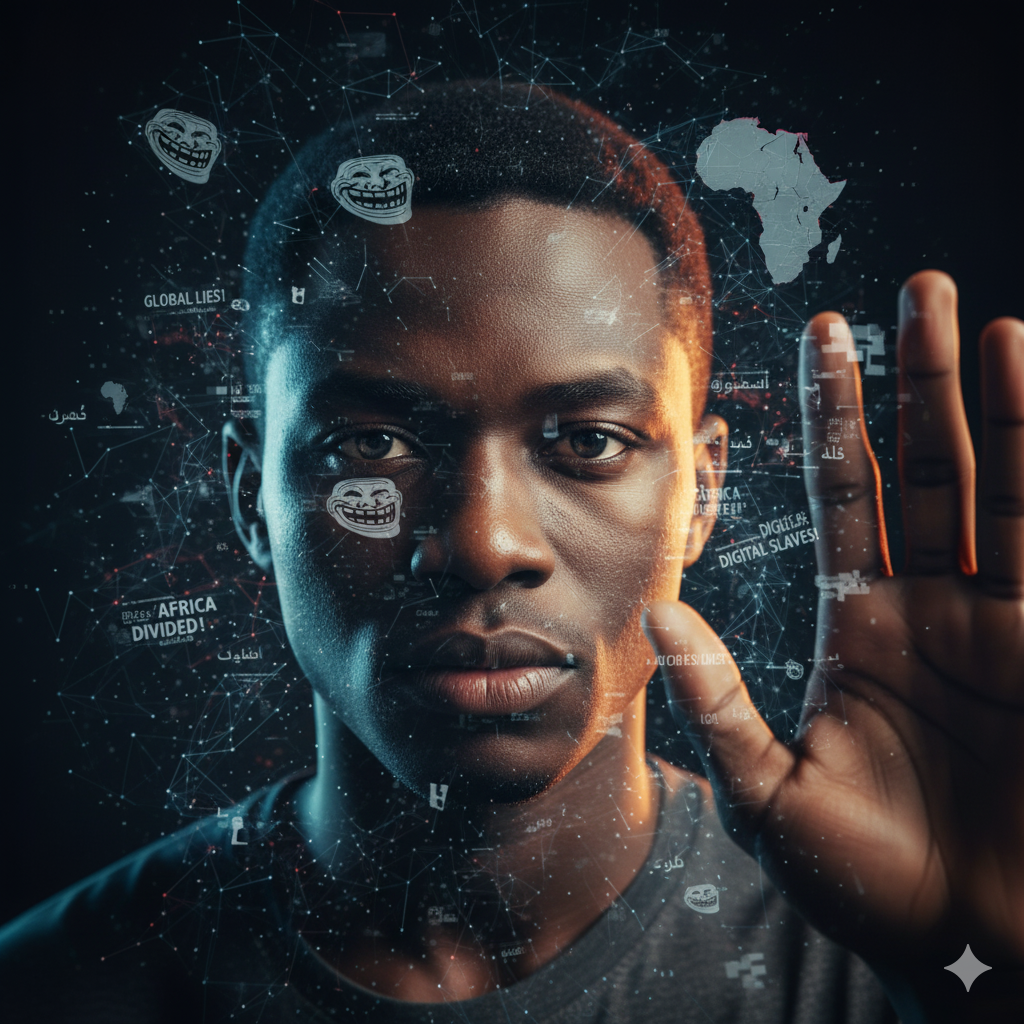
We are witnessing a new Scramble for Africa. But this time, the imperial ships are digital, and the territory being carved up is not land, but the human mind. The weapons are not rifles and treaties, but viral lies and algorithmically amplified discord. A fake video inciting violence in a Nigerian election. A coordinated Facebook campaign in the DRC turning public opinion against a UN mission. A troll farm in South Africa pushing pro-Kremlin narratives about Ukraine.
These are not isolated events. They are battles in a silent, devastating war—a war of information. And its ultimate casualty is African agency: our right to determine our own future based on a shared, verifiable reality. In this multipolar world, our information ecosystems have become the primary theater for geopolitical conflict, and unless we build our defenses, we risk a new form of colonization more insidious than the last.
The New Scramble: The Digital Battlefield
The 21st-century struggle for influence is not fought solely with tariffs or treaties; it is fought with narratives. The world’s major powers—each with its own distinct playbook—are engaged in a relentless campaign to shape African public opinion and policy to serve their own ends.
The Russian strategy is one of chaos and corrosion. It relies on “whataboutism” and the systematic undermining of democratic ideals. By amplifying existing ethnic, religious, and political fractures, it promotes a cynical worldview where all truth is relative, all institutions are corrupt, and the only viable leader is a strongman. It leverages fringe groups and disseminates disinformation that paints the West as an irredeemable hypocrite, creating a vacuum it can fill.
The Chinese approach is one of strategic suffocation. Less overtly destructive, it is designed to silence criticism and control the narrative around its activities. Through paid content, influencers on its payroll, and economic coercion of media outlets, it floods the information space with a relentless “win-win” and “non-interference” narrative. This isn’t about winning an argument; it’s about preventing the argument from happening at all, ensuring that scrutiny of debt traps or labor practices is drowned out by a chorus of manufactured positivity.
Even the Western powers, while cloaked in the language of “human rights” and “democracy,” often engage in a form of narrative manipulation. Their framing can serve to legitimize one faction over another or advance specific corporate interests under a moralistic veil, presenting their preferred outcome as the only “civilized” choice.
The common thread? All three exploit Africa’s most potent social fabrics. They weaponize our diversity, our historical grievances, and our aspirations. They do not create division from nothing; they algorithmically amplify our existing fault lines until the very idea of a collective, national or continental interest becomes impossible.
The Anatomy of a Ghost: The Supply Chain of Lies
To understand the threat, we must dissect the lifecycle of a single disinformation narrative. It operates like a sophisticated, malevolent supply chain.
It often begins with Creation in the shadows: a fabricated document from a shadowy “think tank,” a deepfake video from an anonymous Telegram channel, or a incendiary meme designed for maximum emotional impact.
Next comes Amplification. This is the work of armies of bots and coordinated inauthentic accounts on platforms like X (Twitter), Facebook, and TikTok. These networks, often linked to foreign intelligence services or their proxies, create an artificial sense of consensus and urgency, making a fringe idea trend until it appears to be a mainstream concern.
Finally, the lie is Mainstreamed. Compromised, gullible, or simply overwhelmed local media outlets pick up the “trending” story. Influencers, sometimes knowingly, sometimes naively, repeat it. Eventually, politicians themselves begin to cite the narrative in speeches, granting it a false mantle of legitimacy. The ghost becomes real.
Consider the case of the “Secret US Bioweapon Lab” in West Africa. A narrative with clear Kremlin origins was seeded online, amplified by global bot networks, and eventually cited by local conspiracy theorists and politicians. The result? Erosion of trust in vital public health initiatives and international partnerships, directly undermining continental health security. The lie achieved a strategic objective without a single bullet being fired.
The Collateral Damage: Eroding the Pillars of Society
The impact of this perpetual information war is not merely political; it is civilizational. The ultimate target is not a single election, but the very concept of a shared reality.
We are witnessing The Death of Trust. When citizens can no longer distinguish truth from fiction, the foundation of the social contract—the ability to agree on basic facts to solve common problems—crumbles. Cynicism becomes the default, and citizens disengage, creating a vacuum for authoritarianism.
This leads to Paralyzed Governance. Governments are forced to spend their time and resources constantly fighting fires lit by digital arsonists. Long-term policy planning becomes a luxury when the administration is perpetually reacting to manufactured crises and scandals. The state becomes reactive, ineffective, and ultimately illegitimate in the eyes of its people.
There is also a vicious Chilling Effect. Brave journalists and activists are silenced not only by state force but by orchestrated online mobs that threaten, doxx, and smear them into submission. The cost of speaking truth becomes too high, and the public square is left to the bullies and the bots.
The Firewall: Building African Digital Sovereignty
Defense is not enough. Resilience is not a shield; it is the active, deliberate construction of a healthier, sovereign information ecosystem. We must build a firewall comprised of infrastructure, institutions, and philosophical clarity.
1. Infrastructural Sovereignty:
We must reduce our dependency on platforms that serve as vectors for attack. This means strategic investment in African-owned social media platforms, search engines, and cloud services. This is not about building digital walls, but about creating a homegrown digital public square whose rules and algorithms are not subject to Silicon Valley’s whims or the access of foreign intelligence services. Furthermore, Digital Literacy must become a core subject from primary school, taught not as a technical skill but as a essential civic duty—a modern-day form of critical thinking for national security.
2. Institutional Resilience:
We need an active defense. Imagine a pan-African, publicly-funded “Counter-Disinformation Task Force”—a “White Cell.” Its mandate would not be censorship, but forensic journalism and public alerting. It would identify, analyze, and debunk coordinated inauthentic campaigns in real-time, publicly exposing their origins, methods, and funders, much like Bellingcat does for open-source conflict intelligence.
Simultaneously, we must foster a New Journalistic Model. The future lies in reader-funded, non-profit investigative centers whose sole allegiance is to the public. Their credibility, built on transparency and rigorous ethics, becomes their currency and their shield.
3. Moral & Philosophical Clarity:
Our most powerful weapon may be our own worldview. The philosophy of Ubuntu—”I am because we are”—is the ultimate antidote to the hyper-individualistic, divisive logic of disinformation. It is a call to prioritize communal truth and well-being over the viral lies that tear the community apart. It reminds us that a lie that harms my neighbor ultimately harms me.
This must be translated into a Foreign Policy of Information Self-Determination. African nations must collectively declare that their information space is not a proxy war zone. This means establishing clear diplomatic and economic consequences for foreign governments caught orchestrating influence operations and holding tech giants accountable for the weaponized architecture of their platforms.
Conclusion: The Fight for the African Soul
The weaponized narrative is the newest, most insidious form of neo-colonialism. It seeks to colonize the mind, to convince us that we are incapable of discerning our own truth or determining our own destiny. The struggle for Africa’s future will be won not only on physical battlefields or in boardrooms, but in the news feeds, WhatsApp groups, and collective psyche of its citizens.
To win, we must build our own walls, not of brick and mortar, but of truth, trust, and technological self-determination. We must see this information war not as a peripheral issue, but as a central, existential threat to our sovereignty. The mind is the final frontier of liberation. The fight for the narrative is nothing less than the fight for the African soul.