They told us the world is not enough. That there is not enough food, not enough water, not enough time, not enough homes, not enough land, not enough money. That your suffering is natural. That poverty is inevitable. That hunger is a fact of life. That inequality is the price of progress. But they lied.
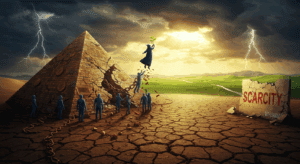
Scarcity is not a law of nature. It is a law of power. And it has been weaponized — not to reflect reality, but to control it.
Let us begin with the facts. The world produces enough food to feed more than 10 billion people, yet over 800 million go to bed hungry. There are more empty homes than homeless people on Earth. Mountains of unsold clothes rot in landfills while children walk naked in the streets. Pharmaceutical companies destroy unsold medicine while the sick die without treatment. Digital abundance flows freely, yet access is metered, firewalled, sold back to us byte by byte. This is not scarcity. This is orchestrated deprivation.
Scarcity is not the result of nature’s limits. It is the result of human choices — or more precisely, the inhuman logic of profit.
From the beginning, scarcity has been manufactured to preserve hierarchies. In ancient empires, food was hoarded by the ruling class while the peasants starved. In feudal Europe, common land was enclosed and privatized, not because it was scarce, but because it was abundant — and free. The crime was not insufficiency. The crime was access.
Today, under capitalism, the lie of scarcity is the engine of consumption and control. It tells you that everything is running out — except, of course, your labor. That will always be abundant. You are told to hustle for your basic needs while billionaires hoard more than they can spend in a thousand lifetimes. You are told to “work hard” while your work is devalued, underpaid and often automated. You are told that universal healthcare is unaffordable, while the arms industry receives trillions. You are told that there is not enough money for public education, but somehow there is always enough for bank bailouts, tax havens and luxury space flights.
Scarcity is not a reflection of the Earth’s limits. It is a reflection of elite imagination. A hoarder’s hallucination imposed on billions.
And here is the heretical truth: nature is abundant. Photosynthesis generates more biomass than all of humanity could consume. The sun floods the planet with energy far beyond our needs. Seeds multiply. Forests regenerate. Oceans teem with life. Water cycles itself. Human ingenuity produces technological abundance daily — from 3D printing to solar panels, from AI to automation. The problem is not production. The problem is permission.
We are governed by artificial scarcity — a scarcity encoded in property rights, patents, paywalls and profit margins. A scarcity that says food is wasted unless it is sold. That life-saving drugs must be priced by “market value.” That knowledge must be locked behind paywalls and subscription models. That even time and attention are monetized.
Look closer and you’ll see how deeply this myth is embedded: scarcity is sold to children when school lunches are denied for lack of funds. It is reinforced in adults through unpaid internships, job insecurity and credit debt. It is preached in economics departments where limitless “demand” meets limited “resources,” without ever questioning who defines either. It is broadcast in advertisements that whisper: “You are not enough — but we can sell you a piece of wholeness.”
This lie persists because it serves. It serves landlords who raise rents under the pretext of “housing shortages.” It serves tech monopolies that create artificial constraints on digital content. It serves politicians who use scarcity to justify austerity while funding endless wars. It serves corporations who treat abundance as a crisis — because when something becomes too available, it stops being profitable.
Abundance is only profitable when it is fenced, taxed, or tiered. In other words, abundance must be disguised as scarcity to be monetized.
And here lies the greatest obscenity: scarcity does not only affect material goods. It seeps into the soul. We begin to believe we must earn rest. That love is limited. That dignity is a competition. That happiness must be bought. That meaning must be productive. We internalize scarcity until it becomes self-hatred.
But the soul knows better. The body knows better. Indigenous cultures knew better. They practiced economies of gift, reciprocity and regeneration, not of hoarding and debt. They lived in communion with abundance, not in fear of lack. Even now, communities thrive through mutual aid, cooperatives, open-source platforms and resource sharing. These are not utopias. These are blueprints.
Empirical evidence shatters the scarcity myth. Studies show that countries with universal basic income, food security programs, and decommodified public goods do not collapse — they thrive. Cooperative models outperform shareholder models in long-term sustainability. Open access to knowledge accelerates innovation. But the myth persists — not because it is true, but because it is profitable.
Scarcity, then, is not the absence of things. It is the presence of systems that withhold those things. It is not a natural disaster. It is an engineered condition.
So let us speak clearly now: scarcity is the theology of capitalism. It is its sacrament and its sword. It is the story told to slaves to make them grateful for crumbs. It is the justification for billionaires and beggars sharing the same street.
To shatter this myth, we must stop asking whether there is enough. There is. We must ask instead: Who owns it? Who gates it? Who benefits from the lie?
The revolution begins the moment we name the lie. And we have named it.
Let it fall.