Editor’s Note:
This statement reflects PowerAfrika’s official position on the ownership and governance of Africa’s natural resources. It is not merely a commentary on one case, but a sweeping indictment of a system that has turned the people’s inheritance into private spoils.
By the Chief Counsel of PowerAfrika
May it please the Court of History—and may the conscience of the African nation bear witness.
Today, we bring before this sacred tribunal not a single man, but an entire government—a state that has betrayed its people and violated the covenant of stewardship enshrined in its own Constitution. The charge is grave: the Republic of Ghana stands guilty of ecological treason, fiduciary breach, and moral bankruptcy.
Under the pretext of development and legality, the Ghanaian state has presided over the wholesale destruction of its rivers, forests, and farmlands, licensing greed where there should have been guardianship. It has become both the arsonist and the fireman—condemning illegal miners with one hand while issuing private concessions with the other.
The evidence is irrefutable:
-
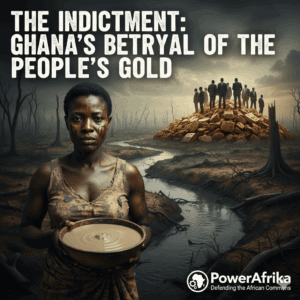
The Pra, Ankobra, and Offin rivers, once the lifeblood of communities, now run brown with mercury and cyanide.
-
Villages that once fetched water freely from nature’s cup must now purchase sachet water to survive.
-
Cocoa farms, Ghana’s golden export, are collapsing under the weight of poisoned soils.
-
The forests of Wassa, Dunkwa, and Tarkwa—once humming with life—are now silent, dead landscapes.
This is not development; it is desecration. Not progress, but plunder dressed in policy.
I. The Constitutional Betrayal
Under Article 257(6) of Ghana’s 1992 Constitution, all natural resources—minerals, water, forests—are vested in the President on behalf of, and in trust for, the people of Ghana.
Trust, by its nature, imposes a fiduciary duty: a sacred legal and moral obligation to act for the benefit of the true owners—the people. Yet what we have witnessed is a grotesque inversion of that duty. The trustee has become the thief; the steward, the exploiter.
Through the Minerals and Mining Act (Act 703), the state has legalized dispossession, transforming communal wealth into private fiefdoms. The Constitution envisioned trusteeship; the government delivered privatization under the seal of legality.
When individuals—politicians, businessmen, and regional warlords—can hold private consignments of gold and other minerals, what remains of the people’s ownership? How can a farmer in Dunkwa claim sovereignty over his river when it has been mortgaged to profit-seekers with political protection?
The law, instead of being the bulwark of justice, has become the crowbar of plunder.
II. Galamsey and the Ecology of Greed
The galamsey crisis is not merely an environmental issue—it is a moral apocalypse. It reveals a nation that has lost its sense of the sacred, trading the purity of its rivers for the illusion of quick wealth.
But let us be clear: galamsey does not exist in a vacuum. It thrives because the formal system mirrors it.
When elites secure “legitimate” mining licenses while peasants are jailed for illegal mining, the injustice is not just social—it is structural.
The result is catastrophic:
-
Water bodies across six regions are now unsafe for human consumption.
-
The Ghana Water Company spends millions annually to purify water that should have been free.
-
Fisheries and aquatic life are collapsing.
-
Children in mining communities suffer mercury poisoning and skin diseases from contaminated sources.
And yet, the government continues to issue mining licenses—both large and small-scale—as if signing death warrants for ecosystems and communities alike.
This is not governance; this is the commodification of life itself.
III. Natural Law and the People’s Claim
Long before constitutions were written, there was a higher law—the law of nature and moral reason—that no statute can annul. It declares that what is given by creation belongs to all equally, not to a privileged few.
From Aquinas to Nkrumah, the principle stands:
“The resources of the land are the birthright of the people, not the inheritance of rulers.”
By this measure, the Ghanaian state has not only broken human law; it has offended divine and natural order.
When rivers are poisoned, the right to life is violated. When forests are destroyed, the right to survival is denied. When wealth is privatized, freedom becomes fiction.
IV. Colonialism in Kente
We were told independence meant self-rule. But what is self-rule when local elites exploit their people with the same precision as colonial companies once did?
Internal colonialism—that is the true name of this system.
Foreigners once plundered with gunboats; now Ghanaians plunder with executive signatures. The faces have changed, the flag has changed, but the logic of extraction remains the same.
This is colonialism wearing Kente, plundering the same soil for the benefit of the same global circuits of capital.
V. The PowerAfrika Doctrine: Resource Sovereignty
PowerAfrika holds that no nation can be free until it controls, protects, and benefits from its natural resources in the name of its people.
We therefore demand:
-
The abolition of all private mining consignments and elite concessions.
-
The establishment of a People’s Resource Trust—a public body bound by law to manage minerals, water, and forests transparently, with direct citizen oversight.
-
Criminal prosecution of individuals and corporations whose activities have destroyed rivers and ecosystems—without regard to political office or affiliation.
-
A moratorium on all new mining licenses until a national environmental audit is completed.
-
The recognition of environmental destruction as a crime against humanity and future generations.
This is not radicalism; it is restitution. It is the recovery of what was stolen in the name of legality.
VI. Judgment Before History
Let it be known that PowerAfrika indicts the Republic of Ghana—not to shame, but to awaken. To call a nation back to its moral senses.
A state that cannot guarantee clean water to its people has forfeited its moral mandate to govern.
Every poisoned river is an affidavit against the government.
Every dying forest is a witness for the prosecution.
Every child without clean water is an exhibit of national betrayal.
The verdict of history will be severe. But redemption is still possible—if Ghana renounces the cult of greed and reclaims the path of stewardship.
Let the rivers live. Let the forests heal. Let the people own what is theirs.
For if we fail to defend the earth that bore us, the earth itself will rise in judgment.
Postscript: The People’s Petition for Resource Sovereignty

PowerAfrika calls upon all citizens, journalists, lawyers, environmentalists, traditional leaders, and students to join a People’s Petition for Resource Sovereignty—a national demand that the Ghanaian government:
-
End private exploitation of public wealth,
-
Restore damaged ecosystems,
-
And legislate the people’s permanent control over their natural inheritance.
Let every voice become a signature.
Let every river become a witness.
Let every citizen become a custodian.

The earth belongs not to presidents or parties, but to the people—and the generations unborn.
PowerAfrika: For the Restoration of the African Commons. 🌍