When Greed Becomes Governance and Silence Becomes Sin
By the PowerAfrika Legal & Moral Council
“When a people forget the sacredness of their rivers, the rivers will rise against them.” — Akan Proverb
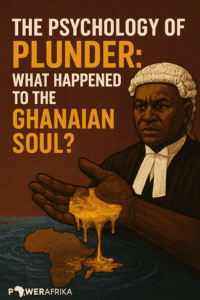
There comes a time in the life of a nation when the enemy is no longer foreign, but domestic — when the flag itself becomes complicit in betrayal. Ghana, the once radiant promise of African independence, now stands at that threshold. What began in 1957 as a covenant of liberation has curdled into a national pathology: greed without shame, ambition without morality, and governance without stewardship.
This is not merely political decay. It is spiritual rot. A moral disease that took root not yesterday, but in the very architecture of colonial rule — a disease I call the Colonial Gene of Greed.
I. The Colonial Gene of Greed
Colonialism did not only steal our gold; it rewired our psyche. The British Crown may have departed, but the colonial instinct — to take without giving, to exploit without accountability — remained embedded in our institutions, our politics, even our definition of success.
The colonizer extracted; the postcolonial elite inherited the appetite. The extraction simply changed color. The flag replaced the Union Jack, but the logic of plunder stayed intact.
We were taught to admire power, not virtue; to worship wealth, not wisdom. And so, decades later, our rivers are poisoned, our forests stripped bare, our moral compass shattered — and yet, we applaud thieves for “making it.”
II. The Living Symptom: Chairman Wontumi
Enter Bernard Antwi Boasiako, known to all as Chairman Wontumi — the perfect symptom of this postcolonial affliction.
A man who boasts openly of owning over one hundred houses in Kumasi alone. Who commands more than seventy excavators. Who drives the finest automobiles imported from every corner of the globe. Who flaunts gold on camera like a priest flaunting incense before an idol. Who proclaims, without irony, that he is richer than the sitting President of the Republic — as though theft were divine grace.
And now, this same man stands before the High Court of Ghana, charged in connection with illegal mining activities that have defiled the very earth that birthed him.
But let us be clear: Wontumi is not the cause of Ghana’s sickness — he is its face. The reflection of a nation that confuses cunning for intelligence and corruption for success. He is the logical product of a state that has made crime a career path and impunity a birthright.
III. The Complicit State and the Silence of the Bench
Here lies the heart of the matter — the state itself has become an accessory to plunder.
By issuing private mining licenses to individuals under the guise of “local investment,” by turning a blind eye to illegal mining (galamsey), and by allowing rivers like the Pra, Ankobra, and Offin to be reduced to toxic sludge, the Ghanaian government has betrayed Article 257(6) of its own Constitution — the sacred clause that declares:
“Every mineral in its natural state in, under or upon any land in Ghana… shall be vested in the President on behalf of, and in trust for, the people of Ghana.”
Trust. That is the operative word.
But trust has been desecrated.
The President holds these resources not as owner but as trustee. Yet what we see today is trustees behaving like monarchs — converting collective wealth into private fiefdoms, and issuing “consignments” as though the earth were their personal estate.
And so, to the Honourable Justice Audrey Kocuvie-Tay, who presided over the Accra High Court bail hearing on 7 October 2025, we say with utmost solemnity: history is watching. This trial is not merely about one man’s guilt or innocence; it is a referendum on the moral threshold of a republic.
If Your Ladyship falters, Ghana will stand naked before her children, condemned by the silence of those entrusted with judgment. Neutrality, in such an hour, is not virtue—it is complicity. Justice delayed will not only be justice denied; it will mark the burial of the Ghanaian conscience beneath the rubble of its poisoned rivers and plundered lands.
You are not presiding over a mere docket of evidence and witnesses. You stand at the intersection of law and destiny, where nations either redeem their honor or lose their soul. The court is no longer just a chamber of legal argument—it has become the confessional of a wounded people seeking redemption.
Let the verdict speak not to privilege, but to principle. Let it declare that no man, no political party, and no license of convenience can stand above the collective will of the people. For when law ceases to defend the common good, it becomes the language of theft; and when theft becomes law, resistance becomes the duty of the people.
IV. The Mirror and the Madness
Let us be brutally honest: the government’s negligence is not merely administrative — it is existential. Our rivers are dying. Our food is poisoned. Children are drinking sachet water laced with mercury. Farmers are abandoning once fertile land. And yet, we are told this is “development.”
What madness is this?
A people who once revered the river gods now dump cyanide into their sacred waters. Chiefs who once swore oaths of stewardship now trade land for envelopes. Politicians campaign with slogans of patriotism while taking kickbacks from mining barons.
And the ordinary Ghanaian, exhausted and disillusioned, either looks away or dreams of joining the feast. The sickness has metastasized from the top to the bottom — the ruler and the ruled now drink from the same poisoned well of greed.
V. A Call to Conscience
Ghana does not need another policy; it needs repentance.
The moral foundation of this republic must be rebuilt from the ground up. The soil itself cries out for justice. Our rivers mourn. Our forests remember.
We must reclaim the Ghanaian soul — the spirit of stewardship, the dignity of labor, the humility before creation that our ancestors once embodied.
And to the court, to the government, to the citizen: understand this — this trial is not about Wontumi alone. It is about whether Ghana still has a conscience, or whether we have traded it for gold dust and applause.
If the state cannot protect what belongs to all, then the people must rise and reclaim what is rightfully theirs.
“When law becomes the language of theft, resistance becomes the duty of the people.”
— PowerAfrika Legal & Moral Council