
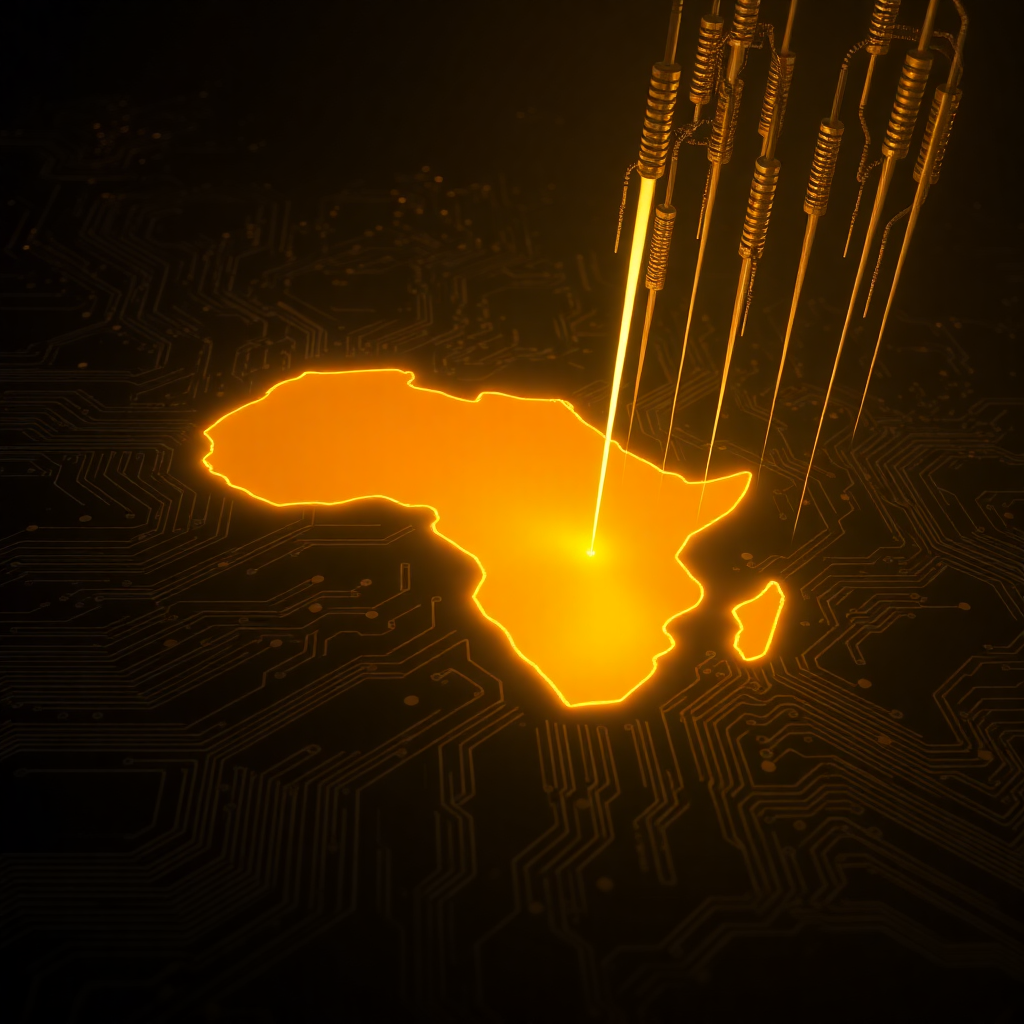
They are mapping us. Not our rivers or mountain ranges, but the intricate topography of our desires, our movements, our relationships, and our fears. This new cartography is drawn not on parchment, but in silent, air-conditioned server farms in Virginia and California. Every tap, every search, every “like” from Accra to Addis Ababa is a data point, a pixel in a portrait of Africa being painted by distant powers for their own profit and prediction. This is the silent, second Scramble for Africa, and the territory is our very consciousness.
For centuries, the colonial project was defined by the extraction of tangible resources—human bodies, gold, rubber, diamonds. Today, the logic of extraction remains, but its target has evolved. The most valuable resource is no longer beneath our soil; it is generated between our ears and transmitted through our fingertips. If the 20th-century struggle was for political independence, the defining battle of the 21st is for digital sovereignty: the right to own, control, and derive value from the data we create.
From Rubber to Data: The Unbroken Chain of Extraction
The parallels between the old and new colonialisms are not merely poetic; they are structural. The Belgian king’s Congo Free State monopolized rubber and ivory, mutilating those who failed to meet quotas. Today, tech giants monopolize attention and data, employing algorithms that psychologically manipulate users to maximize “engagement”—a modern-day quota measured in screen time.
This is data colonialism. It operates on the same core principle: designate a resource in the periphery (African data) as raw, unrefined, and free for the taking, process it using infrastructure in the core (foreign data centers and AI models), and then sell the finished product back to the periphery at a premium, or use it to exert influence. We provide the raw behavioral ore; they manufacture the persuasive algorithms and intelligence. The value chain remains brutally asymmetrical. We are not participants in the digital economy; we are its primary input.
The Geopolitical Chessboard: Warlords and Wizards
The contest for this new territory is a triangular war, with each global power employing a distinct strategy.
-
The Wizards (Silicon Valley): Their strategy is one of benign hegemony. They offer “free” services—a digital mirror that shows us a reflection so captivating we forget it is also a one-way pane of glass. Their language is one of connection and community, obscuring a business model predicated on the mass surveillance and behavioral prediction of African youth. They are building the continent’s central nervous system and owning the proprietary code to read its every signal.
-
The Warlords (Authoritarian States): Their approach is one of infrastructural capture. They lay the digital pipes and roads—the 5G networks, fiber optic cables, and smart city grids. With this comes the hardware, the standards, and crucially, the backdoor access. This isn’t about selling ads; it’s about shaping the very architecture of our future societies to be compatible with their model of state control and censorship. The infrastructure itself becomes a tool of geopolitical leverage.
Opposing this is not a Luddite rejection of technology, but a demand for a fundamental reordering of power. The question is not if we should be connected, but on whose terms?
The Firewall of the Future: Building a Sovereign Digital Commons
Digital sovereignty is not achieved by unplugging from the world. It is achieved by building our own tables, not just asking for a seat at someone else’s. This requires a three-pillared strategy of radical self-interest:
-
Infrastructural Sovereignty: We must treat data like a strategic national asset, akin to water or electricity. This means investing in and legislating for pan-African data centers, cloud infrastructures, and internet exchange points. Our data should, by default, be stored and processed on soil governed by African law. The African Continental Free Trade Area (AfCFTA) must have a digital chapter with teeth, creating a single, regulated market for data flows that protects our collective interest.
-
Regulatory Muscle: GDPR-style data protection laws are a start, but they are a defensive measure. We need offensive regulations that mandate local data processing for critical sectors (health, finance, governance) and require technology transfer as a condition of market access. We must break the comprador class of local elites who, much like their historical counterparts, facilitate this extraction for a slice of the profit.
-
Cultural and Philosophical Reclamation: Our greatest weapon may be our worldview. The philosophy of Ubuntu, “I am because we are,” is the antithesis of the hyper-individualistic, data-hoarding model of Silicon Valley. It suggests a framework for data that is communal, held in trust, and used for the collective good. We must build platforms that reflect this, where value is shared and governance is participatory.
Conclusion: The Right to a Future
The struggle for digital sovereignty is the struggle for the right to a future we author ourselves. Without it, we risk a new form of predestination, where algorithms we did not build and interests we do not share map out our economic pathways, our political choices, and our social realities. They are not just mining our data; they are mining our potential.
Liberation in the digital age will not be declared with a flag alone, but with the quiet hum of a sovereign server farm, the protective strength of our own laws, and the conscious choice to build technologies that serve the African soul, not just exploit its digital shadow.
The Archive: A Hidden Fact
In 2019, a study revealed that the African continent had more unique mobile money accounts (over 450 million) than the entire adult population of North America and Europe combined. This fact is not just a statistic; it is a profound historical irony. While the West was building a digital world to replicate and monetize social interaction, Africa leapfrogged it, building a decentralized financial infrastructure from the ground up. It proves the capacity for endogenous, context-specific technological revolution. The blueprint for a sovereign digital future may not be found in Silicon Valley, but in the everyday innovations that already pulse through the streets of Nairobi, Dakar, and Kampala.