
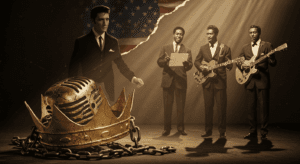
In the golden glare of American pop culture, few names glitter like Elvis Presley. Crowned the “King of Rock and Roll,” he was elevated as an icon, mythologized in white sequins and gyrating hips, paraded across the world stage as a symbol of musical innovation. But beneath the rhinestones and record sales lies a truth long buried under the weight of whitewashed history—Elvis Presley did not invent rock and roll; he inherited it through theft. His crown was forged from the brilliance of Black artists whose names, lives, and legacies were silenced by the very system that crowned him.
At the center of this musical fraud stands Otis Blackwell, a Black songwriter whose pen gifted the world “Don’t Be Cruel,” “All Shook Up,” and “Return to Sender.” Songs made iconic by Elvis but birthed in the soul and mind of a man whom history has largely ignored. Otis didn’t just write hits; he conjured cultural milestones, lacing rhythm and blues with the urgency and sensuality that would define a generation. Yet, while Elvis was thrust into the spotlight and sold as the Southern white boy with a Black man’s sound, Blackwell remained backstage, unpaid in legacy and unrecognized in mainstream lore—a genius forced into the margins.
The exploitation was not accidental, nor was it innocent. It was systematic. In mid-century America, Black artists were prohibited from crossing the racial barriers of mainstream radio and white record companies. Their songs were filtered through white mouths and palatable skin, scrubbed clean of their origins, and sold as cultural innovation. Elvis did not merely borrow a style—he was a vessel through which institutional racism rebranded Black artistry as white genius. And America celebrated.
But perhaps no theft is as cruel as the one committed against Sister Rosetta Tharpe, the godmother of rock and roll. Long before Elvis ever touched a stage, Rosetta was fusing gospel with blues, shredding electric guitar with sanctified swagger. Her style, her fire, her very musical DNA formed the backbone of rock. Yet while she rocked church halls and street corners, Elvis was vaulted into the national consciousness. He mimicked the sound, the flair, the rhythm—and was rewarded for it. She innovated; he imitated. She broke ground; he broke records.
Equally indispensable to this stolen legacy is Chuck Berry, the architect of rock and roll’s enduring spirit. Chuck’s electrifying guitar riffs, sharp storytelling, and charismatic stage presence shaped the genre’s very blueprint. His song “Johnny B. Goode,” a semi-autobiographical anthem celebrating Black youth and talent, became the single most iconic rock and roll song, even launched into space aboard the Voyager Golden Record as a symbol of human culture. Yet, for all its worldwide acclaim, Chuck Berry’s contributions were obscured within mainstream narratives that favored white performers.
The erasure of Berry’s genius was no accident. He was relentlessly targeted by a justice system that sought to undermine him, in stark contrast to the protection and adulation Elvis received. Legal battles, character assassination, and systemic neglect of royalties marked Berry’s career. Meanwhile, Elvis’s sanitized image became the face of a genre birthed in Black creativity.
Chuck Berry’s story embodies the broader mechanism by which Black music was appropriated and commodified by white America. The culture was stolen, the artists sidelined. This was not mere happenstance—it was structural. White record executives, segregated radio stations, and a racially biased industry apparatus all conspired to cloak Black innovation in a veil of whiteness and profit.
Some defenders argue that Elvis loved Black music, that he respected its creators. But love without justice is not respect. To benefit from a people’s pain without challenging their erasure is complicity. Elvis never dismantled the pedestal he was placed upon. He did not speak their names. He never insisted Otis Blackwell, Sister Rosetta Tharpe, or Chuck Berry be celebrated beside him. He reaped the riches and left the roots buried.
This is not simply about musical credit. It is about how power works, how culture is colonized, and how white supremacy does not always wear a hood—sometimes it wears a crown and sings with swagger. It is about how Africa and its diaspora continue to have their genius siphoned, their creativity harvested, and their stories hijacked by Western machinery that smiles while it steals.
For PowerAfrika, the task is clear. We must unearth the voices deliberately forgotten, the names relegated to liner notes, the rhythms that were stolen and renamed. We must amplify Otis Blackwell until his name echoes louder than Elvis’s. We must resurrect Sister Rosetta Tharpe and give her the throne she carved before any man claimed it. We must honor Chuck Berry, the architect of rock’s rebellious spirit, who was never allowed to fully reap what he built. We must tell the truth—not out of bitterness, but out of the fierce conviction that no empire built on stolen brilliance deserves to stand unchallenged.
Elvis Presley did not create rock and roll. He profited from it. The crown he wore belonged to others. And it is time, long past time, we returned it.