
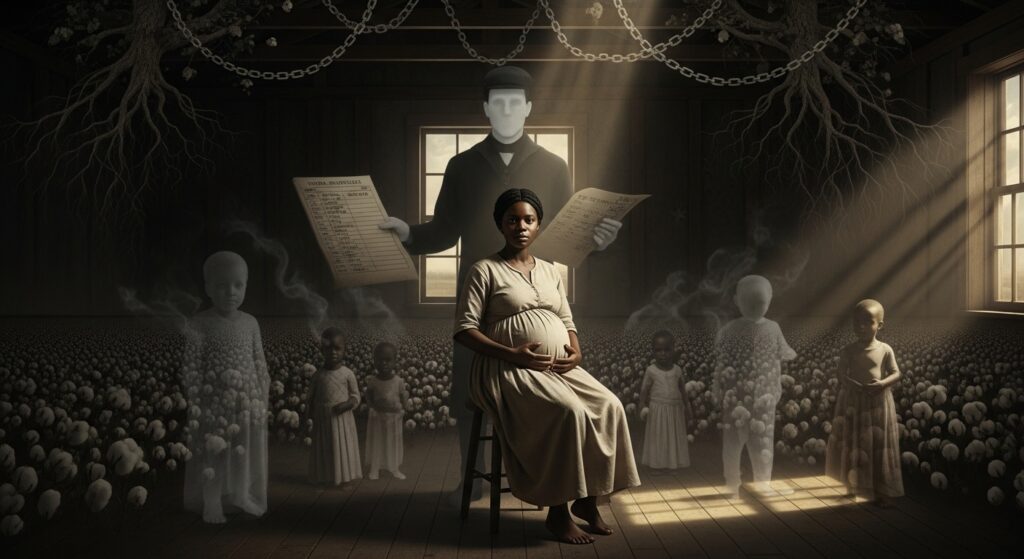
She was never seen as a mother, only as ‘a woman and her increase.’ From stolen wombs came stolen wealth, the silent foundation of America’s empire. We remember, we unearth, and we demand justice.
Introduction: Awakening the Ghosts of History
We are told that history is written by the victors, but what of the histories that are not written at all? What of the stories so horrific, so foundational to a nation’s wealth yet so antithetical to its professed ideals, that they are buried in silence, whispered only in the coded language of ledgers and legal loopholes, in the traumatic pauses between generations?
There is a ghost in the machine of American capitalism, a specter haunting the polished narratives of progress and democracy. It is the specter of the breeding plantation, the “stockman,” the “fancy girl,” the systematic, state-sanctioned coercion of Black wombs to produce human capital. This essay is an act of historical excavation. It seeks not to sensationalize but to sanctify—to restore to the record the stolen agency of enslaved Africans and to expose the calculated economic engine of forced reproduction that built a nation on the principle that life itself could be bred for profit.
I. The Economic Calculus: Capital Made Flesh
The year 1808 was pivotal. Congress banned the transatlantic slave trade, not from moral awakening but from economic calculation. The ban secured the value of the existing enslaved population while catalyzing a domestic trade of even greater brutality.
As Edward E. Baptist notes in The Half Has Never Been Told, more than one million enslaved people were forced from the Upper South to the cotton fields of the Lower South between 1790 and 1860. Virginia and Maryland became exporter states; Mississippi, Louisiana, and Alabama became consumers. Enslavers were not merely planters but entrepreneurs of flesh, making cold calculations about “increase”—the births that expanded their estates.
The logic was simple. Children inherited the condition of their mothers (partus sequitur ventrem). Thus every birth generated profit. A young woman’s fertility meant her value was doubled: she was both a laborer and a producer of laborers. Thomas Jefferson himself admitted the arithmetic: “I consider a woman who brings a child every two years as more profitable than the best man on the farm.” For enslavers, reproduction was not incidental but central to the plantation economy.
The archival record makes this plain: wills bequeathing “a woman and her increase,” advertisements for “breeding women,” plantation account books recording births alongside bales of cotton. Life itself was converted into capital.
II. The Lived Experience: Coercion, Resistance, Kinship
Yet to speak only of economics risks repeating the dehumanization. The lived experience must be brought forward. Enslaved women endured forced pairings, sexual violation by enslavers and overseers, and relentless pressure to conceive. Young girls were monitored for fertility. Men were reduced to “stock.” The figure of the fancy girl—light-skinned women sold for sexual exploitation—reveals the grotesque merger of reproductive, sexual, and economic coercion.
Formerly enslaved people testified to these practices. William J. Anderson recalled his Virginia birthplace under a notorious slave trader who “bred” human beings for sale. Moses Grandy spoke of men kept “for the purpose of breeding children.” Their words break through the silence of ledgers and contracts.
Enslaved women resisted where they could. Some used herbal contraceptives or abortifacients, at great personal risk. Others sought to protect children through escape, concealment, or negotiation. They formed kinship networks, sang lullabies, and embedded identity into fragile family ties—even knowing those ties might be torn apart by sale. Deborah Gray White reminds us in Ar’n’t I a Woman? that Black women were denied both protection and femininity, yet they created spaces of dignity within oppression. Their resistance is part of this story: the assertion of humanity in a system designed to erase it.
III. The Unbroken Line: From Stolen Wombs to Stolen Futures
This was not merely a past atrocity. It was the foundation of American racial capitalism. Jennifer Morgan’s Laboring Women demonstrates that commodified reproduction was central to early modern slavery and racial ideology. The profits from enslaved women’s forced reproduction enriched banks, universities, and dynasties whose fortunes still stand.
The legacies persist. The exploitation of Black women’s fertility evolved into coerced sterilizations under eugenics programs, the surveillance of Black mothers under welfare policies, and the contemporary maternal mortality crisis disproportionately claiming Black women. The racial wealth gap, broken kinship lines, and structural inequities are not accidental. They are the unbroken inheritance of a system that treated Black children as commodities rather than heirs.
IV. Reparations: The Debt for Life Itself
To confront this history is to make the case for reparations. Reparations are not about guilt; they are about debt. They are owed for land stolen, labor stolen, and life itself stolen. Every child born into bondage was an entry in America’s balance sheet, but those children’s descendants inherited poverty, trauma, and exclusion rather than wealth.
Justice requires that reproductive exploitation be explicitly acknowledged in the reparations claim. To speak only of field labor without naming the wombs that sustained the system is to tell a half-truth. Reparations must account for the generations deliberately bred for profit, for the futures denied, for the kinship shattered.
Conclusion: For the Remaking of Humanity Itself
We unearth this history not to dwell in horror but to liberate the future. The system of forced reproduction was perhaps the most complete negation of humanity ever devised, reducing the sacred act of creation to a cold arithmetic. To confront it is to undertake revolutionary truth-telling, to honor the women whose wombs were battlefields and whose children built a nation that denied their humanity.
We call for reparations not merely for the sake of economics, but for the sake of ancestral honor, intergenerational healing, and the remaking of humanity itself. Only by reckoning with this buried history can America hope to be free of its haunting.