A PowerAfrika Post-Mortem of the Man and the Myth
Introduction: The Mythmaker
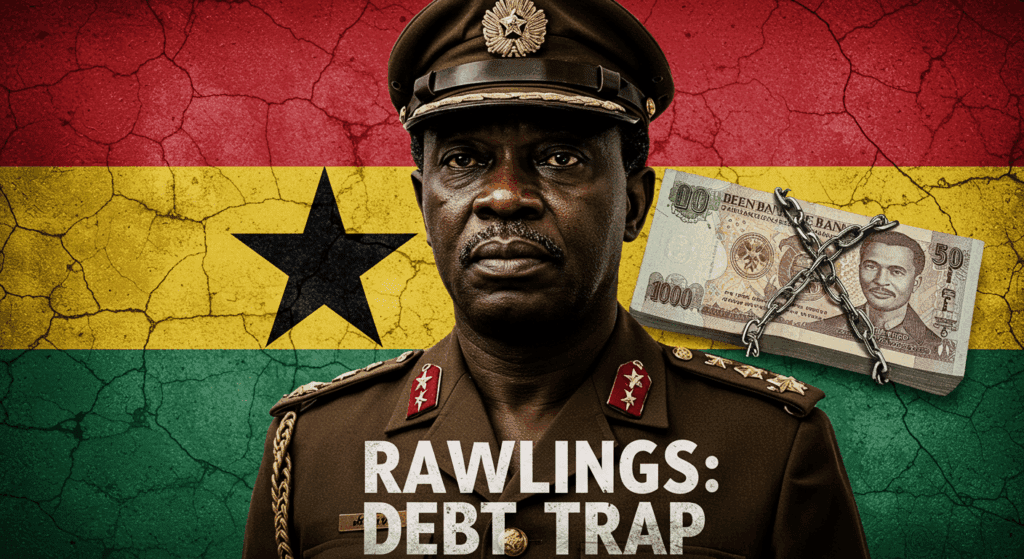
Jerry John Rawlings’ name is etched deep into Ghana’s political memory — sometimes as a savior, sometimes as a tyrant. For nineteen years, he commanded the country’s destiny. His image — the rugged air force officer with a clenched fist — became a symbol of defiance for some, and a warning for others. Yet behind the theatre of populism, Rawlings presided over one of the most decisive economic surrenders in Ghana’s history. He did not merely govern; he re-engineered the political and economic architecture of Ghana in ways that entrenched dependency, hollowed out sovereignty, and indebted generations unborn.
This is not the story of a man betrayed by circumstances. It is the story of an ambitious soldier who cloaked himself in moral outrage, only to mortgage the very nation he vowed to redeem.
The Coup Years: Revolution as Theatre
In June 1979, Ghana was weary. Corruption in the military was rampant, the economy was crumbling, and public trust was shattered. Rawlings emerged as the unlikely messiah — a young flight lieutenant who had failed in an earlier coup attempt in May, stood trial, and used the dock as a pulpit to denounce Ghana’s leaders as thieves. His moral theatrics struck a chord with a desperate populace.
The June 4th Revolution began with the execution of former heads of state and senior officers. It was billed as a purge of corruption. But beneath the revolutionary slogans lay selective justice: the trials were swift, military tribunals were final, and no due process shielded the accused. The violence was surgical — removing certain rivals while leaving others unscathed. It was less about moral cleansing and more about consolidating military power.
When Rawlings handed over to civilian president Hilla Limann later that year, many believed he had honored his pledge to return Ghana to democracy. That illusion lasted two years.
The 1981 Coup: The Day Democracy Died Again
On December 31, 1981, Rawlings struck again. This time, there was no pretence of a short transitional role. He accused Limann’s government of incompetence and declared that Ghana’s problems required “revolutionary” solutions. In truth, Ghana was not in the throes of terminal collapse — Limann’s administration was barely two years old. The 1981 coup was unnecessary, opportunistic, and destructive.
By dissolving parliament, suspending the constitution, and ruling by decree, Rawlings positioned himself not as a caretaker but as Ghana’s unchallenged ruler. It was here that the seeds of economic dependency were sown — in the soil of political monopoly.
The IMF Turn: From Anti-Imperialist to Neoliberal Enforcer
In the early 1980s, Ghana faced real hardships — drought, bushfires, and a shrinking economy. But the solution Rawlings chose would redefine the nation’s trajectory. In 1983, he signed Ghana into the Economic Recovery Program designed by the IMF and World Bank.
The program’s terms were brutal:
-
Currency devaluation by over 1000% over time.
-
Removal of subsidies on essentials like food and fuel.
-
Trade liberalization, opening Ghana to foreign imports.
-
Privatization of over 300 state-owned enterprises, many sold cheaply to foreign corporations.
This was the moment Ghana’s economic sovereignty was traded for short-term stability. Rawlings, once the champion of the common man, became the face of structural adjustment — the very neoliberal orthodoxy that Pan-Africanists had warned against since the 1960s.
Selling the Nation: Privatization and the Hollowing of the State
The roll call of what Ghana lost under Rawlings reads like a catalogue of national betrayal:
-
Ghana Water and Sewerage Corporation — privatized, leading to rising costs and water scarcity for ordinary Ghanaians.
-
State Gold Mining Corporation — key mining assets sold, profits flowing abroad.
-
Ghana Airways — dismantled, replaced by foreign-dominated carriers.
-
State Farms — abandoned, undermining food security.
Foreign companies acquired strategic assets for a fraction of their value, while thousands of workers were laid off. Ghana’s productive capacity shrank, and its dependence on imported goods deepened.
The Shield of Indemnity: Immunity from Justice
In 1992, Rawlings transformed himself from military ruler to elected president, courtesy of a new constitution — one that included an indemnity clause shielding himself and his regime from prosecution for any acts committed during his years in power. This was not the action of a selfless revolutionary; it was the move of a man securing his own future comfort.
The Debt Legacy
By the time Rawlings left office in 2001, Ghana’s debt had multiplied, its strategic industries were in foreign hands, and its economic policy was beholden to Bretton Woods institutions. His rule delivered political stability of a sort — but at the cost of economic captivity. Ghana had traded the visible chains of colonialism for the invisible shackles of debt and dependency.
The Man or the Myth?
Was Jerry Rawlings a revolutionary? The record says no. He was an adept political opportunist — a man who entered power on the back of popular anger, positioned himself as a redeemer, and then presided over the systematic erosion of Ghana’s sovereignty. The myth of Rawlings as a champion of the people survives because it is comforting. But comfort is the enemy of truth.
Conclusion: PowerAfrika’s Verdict
From a Sankocratic and Pan-Africanist perspective, Rawlings’ nineteen years were a wilderness period — a time when Ghana wandered between false promises and real losses. His legacy is not the moral cleansing of the June 4th Revolution, but the economic chains forged in 1983 when Ghana’s destiny was mortgaged to the IMF and World Bank.
For the sake of African sovereignty, the Rawlings myth must be dismantled — not out of spite, but to ensure that future leaders cannot hide economic surrender beneath the camouflage of populist revolution.