Your Excellency,
The decision to rename Kotoka International Airport presents Ghana with something that rarely emerges in public life: a moment when administrative necessity collides with democratic possibility. What appears as a problem of nomenclature is, in truth, an invitation—to define ourselves not through evasion, but through encounter.
We write not as advocates for any particular name, but as citizens convinced that how we arrive at a name matters more than the name itself. The process we choose will teach the nation what kind of republic we believe ourselves to be.
I. WHY THE EASY PATH LEADS NOWHERE
There will be pressure to resolve this quickly. To choose “Accra International Airport” and move on. To treat controversy as something to be managed rather than metabolized.
We urge you to resist this pressure, because a safe name is not a neutral name—it is an active choice with consequences:
It teaches amnesia as statecraft. When we cannot name our gateway to the world, we announce that our history is too volatile to touch, our memory too dangerous to trust. We model for our children that difficult truths are best left unspoken.
It privatizes national identity. A geographic name asks nothing of us. It requires no conversation, no reflection, no choice. It turns citizenship into residency—a matter of location rather than belonging. When we say “Accra International Airport,” we say nothing about which Accra: the Accra of independence dreams, the Accra of military coups, the Accra of youth demanding futures. Geography without meaning is erasure by other means.
It surrenders the pedagogical moment. Millions will pass through this airport. Most will never know why it bears the name it does. A safe name ensures they won’t ask. A chosen name—deliberated, contested, ultimately embraced—becomes a question that leads to our story.
The easy path is not a solution. It is a statement that we prefer comfort to consciousness.
II. THE RENAMING AS REPUBLIC-BUILDING
We propose that this process be conducted not as bureaucratic procedure, but as civic ritual—a national exercise in the difficult, dignifying work of collective self-definition.
Phase 1: The Great Listening (8–12 months)
Regional Assemblies for Naming in all 16 regions, facilitated by trained moderators, documented by national media. Not town halls for venting, but structured dialogues using proven deliberative methods.
Digital platforms ensuring diaspora Ghanaians can participate as full citizens, their distance from the land no barrier to voice in its future.
School-based dialogues where students research, debate, and propose—turning classrooms into laboratories of citizenship.
Thematic streams for proposals:
- Values (Unity, Resilience, Sankofa)
- Unsung heroes and heroines whose lives embody national aspiration
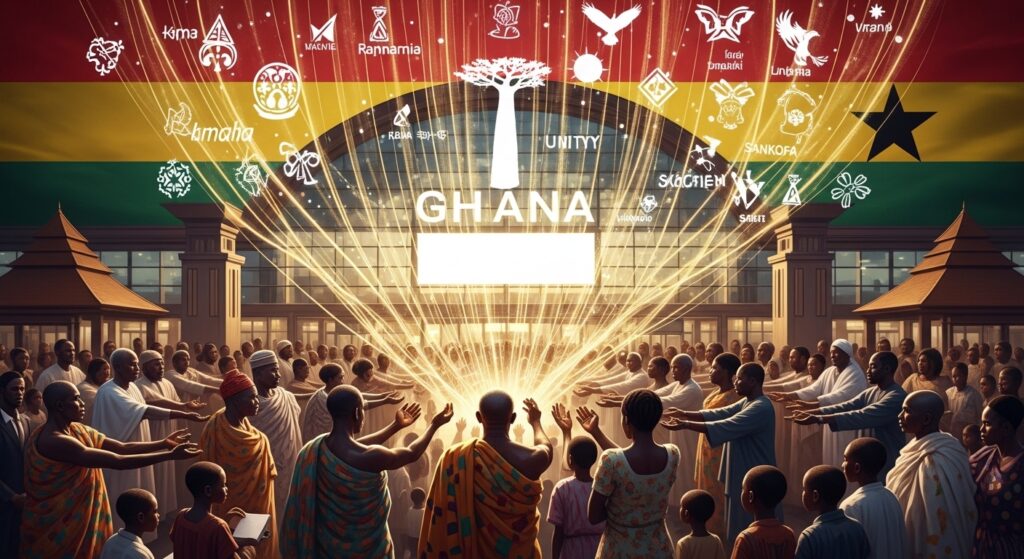
- Ecological and cultural symbols (the eagle, the baobab, the kente)
- Akan, Ewe, Ga, Dagbani, and other linguistic concepts that carry wisdom
Critical requirement: Every proposal must include a “Why This Name?” statement—a public argument, not just a preference.
Phase 2: The Council of Discernment
A transparent, non-partisan body—historians, artists, traditional authorities, youth representatives, linguists, educators—receives all proposals and synthesizes them into a shortlist of 5–7 names.
Crucially, this council does not choose in private. It holds public hearings where each shortlisted name is defended and interrogated. The proceedings are broadcast, archived, and made into educational material.
The council’s role is not to decree, but to curate—to ensure the final options represent genuine diversity of vision, each with a defensible claim to national meaning.
Phase 3: The Choosing
A national referendum on the shortlist, or a televised parliamentary vote preceded by open debate where MPs must publicly justify their choice to constituents.
The announcement comes not in a press release, but on Independence Day or another occasion of collective memory, accompanied by a Declaration of Meaning—a speech, published and archived, that explains to this generation and the next why this name, why now, why this way.
III. THE EDUCATIONAL AFTERLIFE
A new name without new consciousness is cosmetic. This moment must seed a deeper transformation in how we transmit memory.
We propose:
A new subject for basic schools: “Our Symbols, Our Stories”
Not propaganda, but apprenticeship in the work of inheriting contested histories. Students learn:
- Why symbols matter (the story of flags, anthems, monuments globally)
- How to read monuments critically (who built this, when, for whom, what does it hide?)
- The 1966 coup and its aftermath—not as settled truth, but as case study in how nations argue with themselves
- The renaming process itself, documented and taught as a model of participatory democracy
A National Educators Institute on Memory & Pedagogy
Training teachers not to deliver approved narratives, but to facilitate difficult conversations. The goal: classrooms where students can disagree productively about what Ghana means.
A permanent digital archive: “How We Named Our Gateway”
Every proposal submitted, every assembly held, every debate conducted—preserved as open-access record. Future Ghanaians should be able to see not just the name we chose, but the nation we were when we chose it.
IV. WHAT THIS MOMENT TEACHES THE WORLD
Your Excellency, Ghana has long been a model—the first to independence, a beacon of African dignity and democratic resilience. This decision is an opportunity to model something the world desperately needs: how to handle contested symbols without violence, without erasure, without the tyranny of forgetting.
If we rush or retreat to safe neutrality, we tell ourselves and the continent: Symbols are too dangerous for democracy. Let the experts decide. Keep the people distant from the difficult questions.
If we embrace this as collective work, we demonstrate:
That democracy is more than elections. It is the ongoing, uncomfortable, essential work of making meaning together.
That participation creates ownership. When citizens help choose the name, they inherit responsibility for explaining it, defending it, teaching it.
That controversy is not crisis. A nation mature enough to argue about its gateway is mature enough to govern itself.
That memory is infrastructure. How we remember is as vital as what we build.
V. A CLOSING WORD
Your Excellency, you govern during a time when cynicism about public institutions runs deep, when young Ghanaians wonder if their voices matter, when the gap between the governed and those who govern threatens the social contract itself.
This renaming—handled with courage and imagination—can be a down payment on renewed trust. Not because the airport name will solve unemployment or fix roads, but because it can model a government that believes its people capable of wisdom, worthy of being asked, deserving of being heard.
Let this process take the time it needs. Let it be messy, loud, contentious—because that is what genuine democracy sounds like. Let the name that emerges be one we can explain to our grandchildren not as something imposed, but as something we decided—together, in the light, for reasons we were brave enough to speak aloud.
You hold not just a policy decision, but a seed. How it is planted determines what grows: another forgotten sign, or a forest of citizens who know their voices can shape the republic.
Let Ghana’s gateway bear a name chosen by its people, born of its truth, and aimed at its future.
Respectfully submitted,
PowerAfrika
In service of the conscious republic