PREAMBLE: A NATION THAT HONORS ITS EXECUTIONERS
There exists no greater perversity in the architecture of national humiliation than this: that a people should be forced, every single day, to whisper the name of their assassin as they enter and exit their own country.
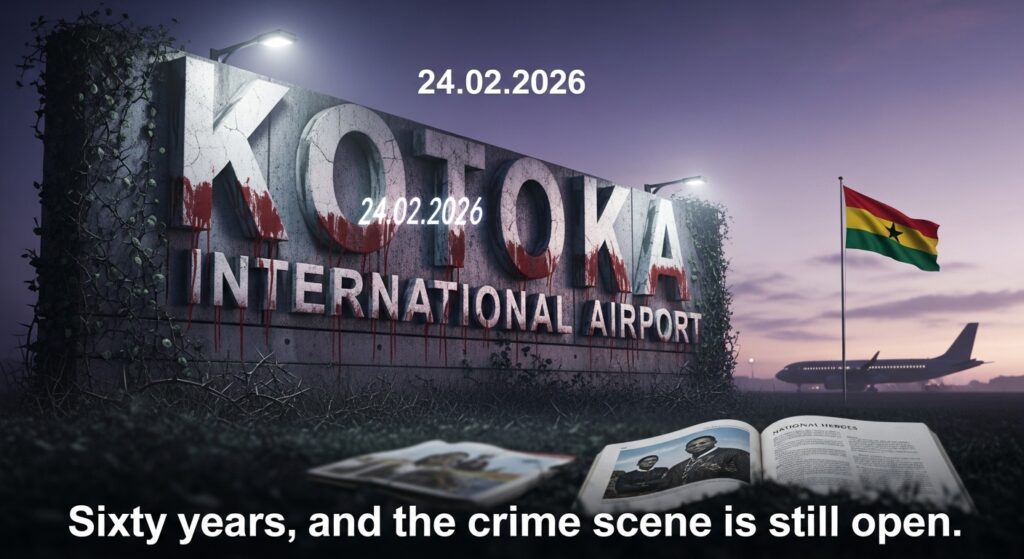
Kotoka International Airport is not infrastructure. It is a psychological torture chamber. It is the scene of an ongoing crime—a daily ritual of enforced amnesia where millions of Ghanaians are compelled to genuflect before the monument to their own subjugation.
This is not metaphor. This is fact.
On February 24, 1966, the future of Ghana—and with it, the future of Africa—was not merely interrupted. It was executed. Shot in the head. Buried in propaganda. And then systematically erased from memory by the very forces that pulled the trigger.
Sixty years later, we live in the world that murder created. And we have been so thoroughly colonized in our minds that we call the murderer a hero and engrave his name above our national threshold.
This essay is not history. It is an indictment.
I. THE CRIME: NOT A COUP, BUT A FOREIGN ASSASSINATION OF AFRICAN POSSIBILITY
Let us be surgically clear about what happened on February 24, 1966.
It was not a “coup d’état.”
It was not a “correction of excesses.”
It was not a “liberation from dictatorship.”
These are the sanitized lies that imperialism tells when it overthrows governments it cannot control.
What happened was an act of imperial warfare disguised as domestic politics.
The CIA and British MI6 did not “support” the coup. They designed it, financed it, armed it, and celebrated it. Declassified documents—hidden for decades and released only under legal pressure—confirm what African patriots have screamed into the void for sixty years: the 1966 overthrow of Kwame Nkrumah was a foreign military operation conducted through local proxies.
Why? Because Nkrumah’s Ghana represented something the colonial order could not tolerate: an Africa that belonged to Africans.
This was not about “mismanagement” or “corruption” or any of the other post-facto justifications the coup-makers invented.
This was about power.
Nkrumah’s crime was not tyranny. His crime was vision. His crime was believing that Ghana—and Africa—could:
- Industrialize without Western “permission”
- Create its own currency and financial systems
- Build factories instead of remaining a source of raw materials
- Educate its own scientists, engineers, and thinkers
- Unite politically and economically into a continental force
- Define its own future on its own terms
For this, he had to be destroyed.
And on February 24, 1966, he was.
II. THE DEVASTATION: A FORENSIC ACCOUNTING OF SIXTY YEARS OF COMPOUNDED LOSS
The true horror of February 24, 1966, is not the coup itself. It is what the coup killed that would have been born.
Let us itemize the murder.
A. The Economic Assassination
What Ghana Lost in Industrial Capacity:
Pre-coup Ghana was not a beggar nation. It was a builder nation. Under Nkrumah:
- The Volta River Project created the Akosombo Dam—the largest man-made lake in the world and a source of renewable energy that could have powered West African industrialization
- The Tema Harbour transformed Ghana into a regional trade hub
- State factories were producing textiles, processed foods, building materials
- The State Housing Corporation was constructing affordable housing on a scale not seen before or since
- Ghana was training engineers, not just importing them
- The African Continental Bank was being planned to free the continent from IMF dependency
What happened after the coup?
Every. Single. Project. Was dismantled, defunded, or handed over to foreign control.
The factories were closed or privatized. The vision of industrial self-sufficiency was replaced with the theology of “comparative advantage”—a economic doctrine that translates to: You grow the cocoa, we’ll make the chocolate. You mine the gold, we’ll make the jewelry. You stay poor, we’ll stay rich.
The result? Sixty years later:
- Ghana remains a primary commodity exporter
- We import nearly everything we consume
- Our currency is perpetually weak because we produce nothing the world needs in finished form
- Youth unemployment is structural because there is no industrial base to absorb labor
- Every generation graduates into an economy designed for extraction, not production
This is not “underdevelopment.” This is arrested development—violently imposed and perpetually maintained.
B. The Political Assassination
The coup did not just remove Nkrumah. It removed the very idea that Ghana could be audacious.
Post-1966 Ghana learned a single, brutal lesson: Do not dream too big. Do not challenge the international order. Do not believe you can build something they did not give you permission to build.
This psychological castration has defined our politics for sixty years.
Every government since has governed in the shadow of the coup. Every leader has understood, consciously or not, that the penalty for true independence is removal. And so we have had sixty years of governments that:
- Beg for foreign aid instead of demanding fair trade
- Accept structural adjustment instead of asserting sovereignty
- Privatize national assets because “the market knows best”
- Send our youth abroad because we cannot imagine an economy that needs them here
The coup taught Ghana to be afraid of its own ambition. And we have been afraid ever since.
C. The Continental Assassination
Nkrumah was not just Ghana’s leader. He was Africa’s prophet of unity.
His vision was not romantic Pan-Africanism. It was hard-nosed strategic realism: that small, fragmented African states would always be prey for larger powers, and that only continental unity—political and economic—could guarantee African sovereignty.
He was right. Sixty years of fragmented independence has proven him right.
But the coup killed that vision before it could take root.
Imagine if Nkrumah’s vision had succeeded:
- An African common market in the 1970s instead of the 2020s
- An African central bank controlling African resources
- An African security architecture that could resist foreign military intervention
- An Africa that negotiated with the world as a unified bloc of 1.4 billion people, not as 54 fragments
The coup did not just kill Ghana’s future. It killed Africa’s future.
And we are living in the graveyard of that murder.
D. The Psychological Assassination: The Deepest Wound
But perhaps the cruelest legacy of February 24, 1966, is this: it taught Ghanaians—and Africans—to internalize the coup-makers’ propaganda.
We learned to call Nkrumah a “dictator” without asking who taught us that word.
We learned to say the coup “saved” us without asking what we were saved from—or what we were delivered into.
We learned to accept that African ambition is dangerous, that African self-reliance is arrogance, that African unity is impossible.
The coup colonized our minds more effectively than any army ever could.
And the proof? We still call the airport “Kotoka.”
We still honor the man who pointed the gun. We still teach our children that treason against African liberation is patriotism.
This is not forgetfulness. This is Stockholm syndrome at the scale of a nation.
III. THE CONSPIRATORS: WHO KILLED FEBRUARY 24, 1966?
Let us name the murderers.
The Foreign Architects:
- The CIA: Declassified documents confirm active involvement in destabilizing Nkrumah’s government, financing opposition, and coordinating with coup plotters.
- British MI6: Provided intelligence, logistical support, and post-coup legitimacy.
- Western Corporations: Mining companies, trading firms, and financial institutions that saw Nkrumah’s nationalization policies as threats to profit.
The Local Executors:
- Emmanuel Kwasi Kotoka: The military officer who led the physical operation—the finger that pulled the trigger.
- Joseph Arthur Ankrah: Head of the National Liberation Council that ruled post-coup.
- The reactionary elite: Ghanaian business and political figures who preferred comprador capitalism to sovereign development.
The Ideological Accomplices:
- Every government since 1966 that has refused to investigate the coup
- Every historian who calls it a “liberation”
- Every textbook that sanitizes imperialism as “intervention”
- Every Ghanaian who says “let’s move on” without reckoning
IV. THE MONUMENT TO MURDER: Why “Kotoka International Airport” Is an Ongoing Crime
To name an airport after Kotoka is not merely symbolic. It is pedagogical violence.
Every time a Ghanaian child hears that name, they are being taught:
- That treason against African self-determination is heroism
- That serving foreign interests against your own people is legacy
- That the assassins of the future deserve monuments
This is not passive memory. This is active indoctrination.
And it is not accidental. The decision to name the airport after Kotoka was deliberate—a message from the coup regime to future generations: Do not resist. Do not dream. This is what happens to those who try.
Sixty years later, we are still receiving that message.
Every arrival. Every departure. Every time we say the name.
V. THE RECKONING: What Ghana Owes Itself Before the 60th Anniversary
February 24, 2026, will mark sixty years.
We have a choice: arrive at that date still whispering the name of our executioner, or arrive having finally reclaimed our voice.
This is what justice demands:
1. Immediate Renaming of the Airport
Not to “Accra International”—that is cowardice.
To a name that repudiates the coup and reclaims the vision it murdered:
- Kwame Nkrumah International Airport: The man whose future was stolen deserves to be the name on the gateway to Ghana’s future.
- Sankofa Gateway: “Go back and fetch it”—the future we lost in 1966.
- Africa Unity International: A commitment to the vision the coup was designed to kill.
2. A National Truth and Reparations Commission
To officially investigate:
- The full extent of foreign involvement
- The economic cost of sixty years of arrested development
- The psychological damage of six decades of enforced amnesia
- Reparations from the governments whose intelligence agencies planned the coup
3. Curricular Revolution
Every Ghanaian child must learn:
- What Nkrumah was actually building
- Who actually overthrew him and why
- What Ghana lost and what Africa lost
- That February 24, 1966, was not liberation—it was execution
4. The Removal of Every Monument to the Coup
Not just the airport. Every statue, every street name, every honor bestowed on those who betrayed the future.
Betrayal does not deserve bronze.
VI. CONCLUSION: THE FUTURE IS STILL WAITING TO BE BORN
Sixty years ago, on February 24, 1966, a gun was pointed at the head of African possibility.
The trigger was pulled.
But the future that was murdered that day is not dead. It is waiting.
Waiting for a generation brave enough to say: No more monuments to murderers.
Waiting for a nation willing to say: We remember what you tried to make us forget.
Waiting for a people ready to reclaim what was stolen.
The 60th anniversary is approaching.
The question is not whether we will remember February 24, 1966.
The question is whether we will finally understand what was killed that day—and whether we have the courage to resurrect it.
Let 2026 not find us still kneeling at the altar of our own assassination.
Let it find us, at last, standing—with a new name above our gateway and an old vision burning in our hearts.
The clock is ticking.
The world is watching.
And the future Ghana lost in 1966 is still ours to build.
PowerAfrika
No more silence. No more monuments to traitors. No more.